

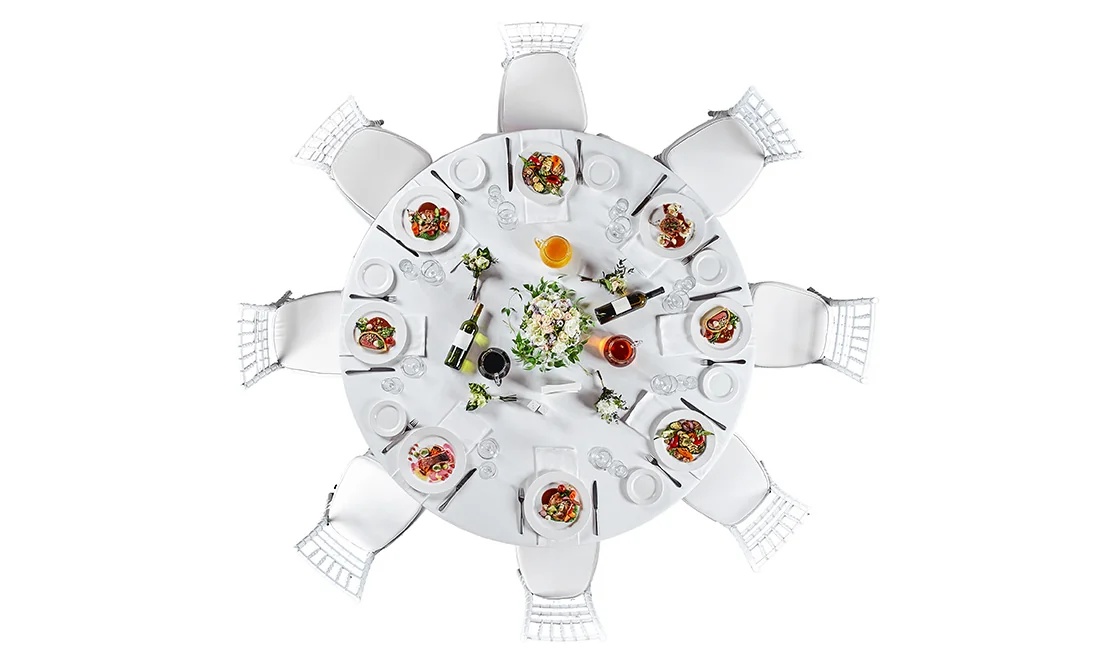
The shape of an event table influences far more than aesthetics. It determines how guests interact with each other, how much personal space each person has, how the room is arranged, and how every plate, glass, and napkin should be positioned on the surface. A round table and a rectangular table create fundamentally different experiences for the people seated at them — and the downstream effects touch every aspect of party setup, from floor plan to fork placement.
This guide compares the two shapes across every dimension that matters for event planning: room layout, guest spacing, conversation flow, centerpiece placement, and tableware arrangement. All spacing guidelines below follow standard hospitality industry recommendations and assume a standard table height of 30 inches.
What Is the Core Difference Between a Round and Rectangular Table Setup?
A round table setup is a circular arrangement where every guest faces the center at an equal distance, with no head or foot position. A rectangular table setup is a linear arrangement with defined ends, creating a directional seating hierarchy where the end seats carry more visual prominence.
This structural difference is what drives every other distinction between the two shapes. Round tables eliminate positional hierarchy entirely — no one sits at the “head,” and every seat has the same spatial relationship to the center and to neighboring guests. Rectangular tables, by contrast, create a natural directional flow. The end positions carry implied authority, which is why head tables at weddings, corporate dinners, and formal banquets are almost always rectangular.
Standard round event tables range from 36 inches in diameter (seating 4 guests) to 72 inches (seating 10–12). Standard rectangular event tables are typically 6 feet long (seating 6–8) or 8 feet long (seating 8–10). The choice between these two geometries cascades into every subsequent setup decision — how the room is arranged, how much elbow room each guest gets, how conversation moves around the table, and how tableware is positioned on the surface.
Does Table Shape Affect the Overall Atmosphere of an Event?
Round tables tend to create a more intimate, social, and egalitarian atmosphere because guests face each other in a closed circle with no dominant position. Rectangular tables produce a more structured, formal, and directional feel — especially when arranged in long parallel rows or configured as a single extended banquet line. The shape sets the tone of the event before any decoration is added.
How Does Table Shape Change the Way a Room Layout Is Arranged?
Round tables are typically arranged in a staggered grid pattern with 60 inches of spacing between them, allowing diagonal movement through the room. Rectangular tables are arranged in parallel rows with 52–54 inches between rows, maximizing linear seating capacity in long or narrow venues.
The geometry of the table dictates the geometry of the room. Round tables require approximately 10 square feet of floor space per guest, while rectangular tables need approximately 8 square feet per guest. This means rectangular setups can seat more people in the same room — a meaningful difference when venue capacity is tight.
However, round tables work better in square rooms, ballrooms, and irregularly shaped venues where straight-line rows would leave awkward gaps. Their curved edges allow them to be placed more flexibly around pillars, alcoves, and irregular walls. Staggering round tables in a diamond pattern — offsetting every other row — can fit roughly 15 percent more tables in a large room compared to a straight grid.
Rectangular tables excel in long, narrow spaces. They align naturally with the room’s geometry, create clean aisles between rows, and double as buffet stations, gift tables, or drink service areas without looking out of place. The minimum aisle width between any tables for safe guest movement and wheelchair accessibility is 36 inches — a standard hospitality guideline that applies regardless of table shape.
Can Round and Rectangular Tables Be Mixed in the Same Event?
Mixing table shapes is a well-established event design technique, not a compromise. A common and effective approach is to use rectangular tables for the head table, buffet stations, and drink service areas while seating guests at round tables. This combination allows each shape to serve its strongest function — rectangular for directional focus and linear food display, round for social guest interaction. The visual variety also adds dimension to the room layout.
How Much Space Does Each Guest Need at a Round Table Compared to a Rectangular One?
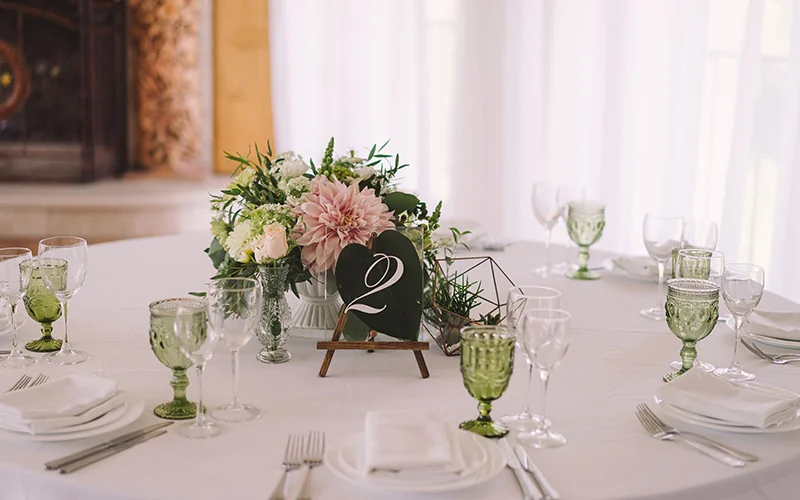
Each guest needs approximately 24 inches of table edge for casual events and 30 inches for formal place settings, regardless of table shape. The difference is geometric: round tables distribute this space along a curved circumference, while rectangular tables distribute it along straight edges.
On round tables, the available seating edge is calculated by circumference — diameter multiplied by 3.14. A 60-inch round table has approximately 188 inches of circumference, which comfortably fits 8 guests at casual spacing or 6 at formal spacing. On rectangular tables, the usable seating edge is typically the two long sides, with end seats added optionally. A 6-foot table provides 144 inches of long-side edge, seating 6 guests at 24 inches each — three per side — with room for one additional guest at each end.
Round tables offer a subtle advantage in tight-squeeze situations. The curved edge creates small natural pockets of space between adjacent settings that straight edges do not, giving elbows slightly more room even at identical per-person allocations.
How Many Guests Fit at Standard Round and Rectangular Tables?
The seating capacity for the most common event table sizes is as follows:
|
Table |
Casual (24″ per person) |
Formal (30″ per person) |
|
48″ round |
6 |
4–5 |
|
60″ round |
8 |
6 |
|
72″ round |
10 |
8 |
|
6 ft rectangular |
6–8 |
6 |
|
8 ft rectangular |
8–10 |
8 |
These numbers assume standard 30-inch table height and do not include high chairs, booster seats, or benches, which alter the spacing calculation.
Why Does Conversation Flow Differently at Round and Rectangular Tables?
Conversation at a round table flows in a 360-degree group pattern because every guest can see and hear every other guest at the same table. At a rectangular table, conversation flows in neighbor pairs — each person primarily speaks with the guests directly beside and across from them.
Round tables encourage whole-table interaction, making them the natural choice for social events where mingling matters — weddings, reunions, networking dinners, and celebrations where guests from different social circles are seated together. A single round table of 8 can sustain one group conversation that includes everyone.
Rectangular tables create conversational “pods” of 4–6 people. Guests seated at opposite ends of a long 8-foot table are unlikely to speak to each other during the entire meal. This is not necessarily a disadvantage — for corporate dinners, family-style meals, and events where small-group interaction is preferred, the rectangular shape channels conversation in a way that feels natural and manageable.
Centerpiece height directly affects these dynamics on both shapes. A tall centerpiece on a round table breaks the 360-degree sight line and defeats the shape’s primary social advantage. On rectangular tables, tall centerpieces mainly obstruct across-the-table eye contact but leave side-by-side conversation unaffected.
Which Shape Works Better When Guests Do Not Know Each Other?
Round tables are generally the stronger choice when guests are unfamiliar with each other. The circular arrangement avoids isolating anyone at the far end of a long table and makes it easier for every person to introduce themselves to the full group. This is why networking events, corporate mixers, and wedding receptions with mixed social groups typically default to round seating.
How Should Centerpieces and Candles Be Placed Differently on Each Table Shape?
Round tables work best with a single, compact centerpiece placed at the exact center, surrounded by small candles or votives in a circular pattern. Rectangular tables work best with a linear arrangement — low décor elements repeated along the table’s length, or one elongated arrangement running down the center channel.
On round tables, the center point is equidistant from every guest, making it the natural and only focal point. One medium-sized arrangement — kept below 12 inches tall so guests can see over it, or raised above 24 inches on a stand so guests can see under it — is the standard approach. Votive candles placed in a ring around the base add warmth without crowding individual place settings.
On rectangular tables, the long surface creates a “stage” for décor. Multiple small arrangements spaced evenly along the center line maintain visual interest from every seat. Candles distributed in a row down the middle create a warm, continuous glow. Pillar candles of varying heights are a budget-friendly way to add visual depth on rectangular tables.
The key constraint on both shapes is that centerpieces and candles must not encroach on the shared center zone — approximately 9 inches deep from each side — where serving dishes, bread baskets, and bottles are placed during the meal.
What Centerpiece Mistakes Can Block Sight Lines or Crowd Place Settings?
The most common error is choosing a centerpiece between 13 and 23 inches tall — too tall to see over comfortably but too short to see under. Centerpieces should be either below 12 inches or above 24 inches on a raised stand. Oversized arrangements that extend past the shared center zone and into place-setting territory are the second most frequent mistake, especially on round tables where the available surface area is more limited.
How Does Table Shape Affect the Way Plates, Glasses, and Napkins Are Arranged?
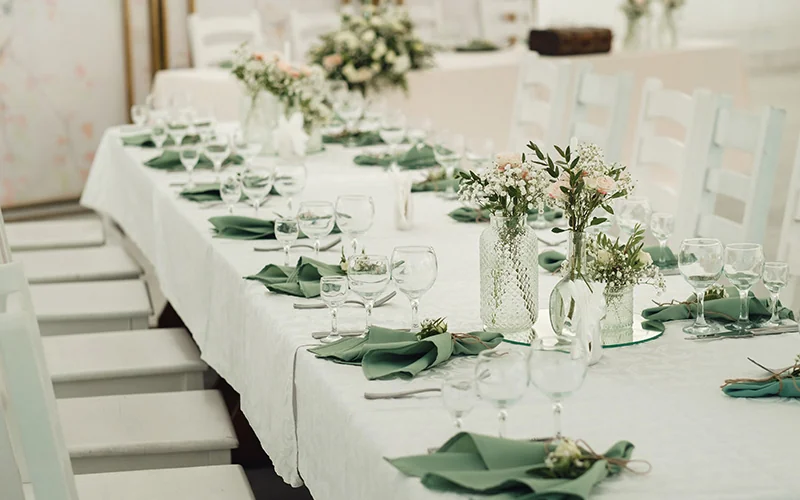
On rectangular tables, each place setting aligns in a straight row along the table edge, with glasses positioned uniformly above the knife line. On round tables, place settings fan out radially from the center, with each setting angled slightly toward the middle and glasses offset to avoid crowding adjacent guests.
The standard place-setting footprint — approximately 18 inches wide and 15 inches deep for casual events, up to 24 inches wide for formal occasions — remains the same regardless of table shape. What changes is the angle and curvature of the arrangement.
On rectangular tables, all settings face the same direction, perpendicular to the long edge. This creates clean parallel lines and makes the table fast to set — identical left-to-right placement at every position. On round tables, each setting radiates outward from the center like spokes on a wheel. The plate center should align with the table edge, and the glass cluster — water glass and wine glass — should sit at approximately the 1 o’clock position relative to the plate. This inward offset prevents neighboring guests’ glasses from colliding, a common problem when glasses are placed in a straight line along a curved edge.
Napkins follow the same spatial logic. On rectangular tables, napkins sit uniformly to the left of each fork or centered on the plate. On round tables, napkins are often placed directly on the plate or tucked into the glass to save lateral space between adjacent settings.
For disposable tableware, the same positional principles apply. Disposable plates, cups, and napkins arranged according to the correct spatial logic for the table shape will look intentional and polished rather than haphazard.
Do Round Tables Require a Different Plate and Glass Configuration?
The plate position remains centered at the table edge for both shapes, but glass placement differs meaningfully. On round tables, glasses should be offset toward the table’s interior — the 1 o’clock position above each plate — rather than placed in a straight line. Straight-line glass placement on a curved edge causes adjacent guests’ glassware to crowd together. At tightly set round tables, choosing slightly smaller plates — such as 9-inch salad or dessert plates instead of 10.5-inch dinner plates — can also improve comfort and spacing.
Which Table Shape Works Best for Buffet, Plated, and Family-Style Service?
Buffet service works best with rectangular tables for both guest seating and food display because of their linear flow. Plated service works equally well with either shape. Family-style service — where shared dishes are passed at the table — favors rectangular tables because their wider center channel accommodates more serving platters.
For buffet service, rectangular tables form the most efficient serving stations. Two or three 6-foot tables lined end to end create a continuous food line. Guest seating in a buffet setup can be either shape, though round tables are often preferred because guests do not need as much table surface once they return with pre-loaded plates.
For plated service, both table shapes perform equally well. Each guest receives a fully prepared plate from the kitchen, so the only difference is the radial versus linear arrangement of the individual place settings.
For family-style service, the center of the table must hold shared platters, bowls, and serving utensils. Rectangular tables provide a continuous center channel that accommodates significantly more serving pieces. A 60-inch round table has roughly 3 square feet of usable shared center space, while a 6-foot rectangular table provides 4–5 square feet.
Where Should Serving Plates and Extra Cups Be Staged for Each Format?
For buffet service, plates and cups should be stacked at the beginning of the buffet line, with cutlery and napkins placed at the end so guests pick them up last and do not have to juggle them while serving food. For family-style service, serving platters remain in the center channel, and spare cups or glasses are placed on a nearby side station to keep the main table surface uncluttered. For plated service, all tableware is pre-set at each place setting before guests are seated.
How Should Hosts Decide Between Round and Rectangular Tables for Their Event?
The decision rests on four factors: venue shape, guest count, desired atmosphere, and service style. The following comparison summarizes how each factor favors one shape or the other:
|
Factor |
Round Tables |
Rectangular Tables |
|
Best venue shape |
Square, ballroom, irregular |
Long, narrow, tent |
|
Space per guest |
~10 sq ft |
~8 sq ft |
|
Conversation style |
Whole-group (360°) |
Neighbor-pairs |
|
Formality |
Social, intimate |
Structured, directional |
|
Centerpiece space |
Limited (1 central piece) |
Generous (linear channel) |
|
Best service format |
Buffet seating, plated |
Family-style, buffet display |
|
Flexibility |
Easy to add or remove 1 chair |
Easy to extend end-to-end |
For most events, the strongest approach is not choosing one shape exclusively but combining both — round tables for guest seating and rectangular tables for the head table, food display, and drink service. The tableware itself does not change between shapes. The same plates, glasses, napkins, and candles work on both — only the spatial arrangement shifts.
FAQs
Which Table Shape Seats More Guests in a Small Venue?
Rectangular tables are more space-efficient, requiring approximately 8 square feet per guest compared to 10 for round tables. In a tight room, rectangular tables arranged in parallel rows will accommodate a larger total headcount.
Is a Round or Rectangular Table Better for a Wedding Reception?
Most wedding receptions use round tables for guest seating because they encourage social mixing and create an elegant, symmetrical room layout. The head table is typically rectangular so the wedding party faces the room. Combining both shapes is the most common wedding configuration.
How Far Apart Should Tables Be Spaced in an Event Room?
The standard minimum is 54–60 inches between round tables and 52–54 inches between rectangular table rows, measured center to center. This provides at least 24 inches of aisle clearance between chairs. For wheelchair accessibility, aisles should be a minimum of 36 inches wide.
Can Square Plates Be Used on a Round Table?
Square plates can be used on round tables, but round plates produce a more harmonious visual effect because they echo the table’s geometry. If square plates are chosen, orienting them in a diamond position — rotated 45 degrees — reduces the risk of corner-to-corner crowding between adjacent settings.
How Many Place Settings Fit on a 60-Inch Round Table?
A 60-inch round table fits 8 place settings at casual spacing (24 inches per person) or 6 at formal spacing (30 inches per person). This is based on the table’s circumference of approximately 188 inches divided by the per-person allocation.