

With growing awareness of plastic pollution, many people are turning to alternatives labeled as biodegradable or compostable. These terms represent different environmental impacts, decomposition processes, and disposal methods. Understanding these differences is key to selecting tableware that is truly eco-friendly.
In this guide, we’ll break down the key differences between compostable and biodegradable tableware, highlighting how each works, their certification standards, and their effects on the environment. By the end, you’ll know exactly which option fits your needs and how to dispose of it responsibly, ensuring your choice is both practical and planet-friendly.
What are Compostable Tablewares?
Compostable tableware refers to plates, cups, and cutlery made from plant-based materials that break down into water, carbon dioxide, and organic matter in a compost system.
Common materials include:
|
Material |
Source |
Typical Use |
|
PLA |
Corn starch |
Cups, lids |
|
Bagasse |
Sugarcane fiber |
Plates, bowls |
|
Palm leaf |
Fallen leaves |
Serving trays |
Benefits of Compostable Tablewares
Below are the benefits of compostable tablewares:
-
Reduces Plastic and Pollution
-
Predictable Composting
-
Supports Cleaner Waste Streams
Compostable tableware reduces reliance on plastic tableware because it uses renewable plant sources instead of fossil fuels. Because these items fully break down in controlled composting systems, they do not leave microplastics behind. For you, this means less long-term soil and water pollution.
Certified compostable products break down within a set time frame under industrial composting conditions, often at 55–60°C. In practice, this translates to predictable waste processing instead of unknown decay times.
Compostable tableware also supports cleaner waste streams. When you dispose of it correctly, it avoids contamination common with degradable plastics and supports eco-friendly tableware programs used by food service and events.
What are Biodegradable Tablewares?
Biodegradable tableware refers to plates, cups, and cutlery made from materials that microorganisms can break down into water, carbon dioxide, and biomass.
Benefits of Biodegradable Tablewares?
Key advantages at a glance:
-
Reduces Long-Lasting Waste
-
Made from Renewable Materials
-
Flexible Disposal Options
You reduce long-lasting waste because biodegradable materials break down faster than conventional plastics. For you, this means less material remains in landfills for decades, which lowers the risk of microplastics entering soil and water.
Many biodegradable tablewares use plant-based inputs like starch blends or cellulose derivatives. Because manufacturers source these from renewable crops, you rely less on fossil-based plastic tableware.
Biodegradable options also offer flexible disposal paths. Some products degrade in soil or home compost over time. In practice, this gives you more options when industrial composting is not available.
What is the Difference Between Compostable and Biodegradable Tablewares?
Compostable and biodegradable tableware break down after use, but they do so under different conditions, timelines, and controls. These differences affect how you dispose of them, what they turn into, and how they impact waste systems and the environment.
Their differences between compostable and biodegradable tablewares are reflected in the following aspects:
-
Decomposition Conditions
-
Decomposition Time
-
End Products
-
Environmental Standards and Certification
-
Environmental Impact
-
Disposal and Waste Management
Decomposition Conditions
Compostable tableware is tableware that breaks down in a compost setting into natural elements without leaving toxic residue. Most certified compostable items need industrial composting conditions, such as steady heat around 55–60°C, controlled moisture, and active microbes. Because facilities control these factors, compostable items break down as designed.
Biodegradable tableware is tableware that microorganisms can break down over time in natural settings like soil or water. These products do not require a compost facility, but the environment matters. Cold temperatures, low moisture, or lack of microbes can slow or stop breakdown.
Decomposition Time
Compostable tableware follows a defined time frame. Standards such as ASTM D6400 or EN 13432 require products to break down within a set period under composting conditions, often within a few months. This rule exists because compost systems need predictable results to produce usable compost.
Biodegradable tableware has no fixed timeline. Some items break down in months, while others take years, depending on material and environment. Products labeled only as degradable may just fragment into smaller pieces.
End Products
Compostable tableware breaks down into carbon dioxide, water, and organic matter that supports plant growth. Certified products must leave no toxic residue and must not harm compost quality. Because of this requirement, compostable items fit into managed compost systems.
Biodegradable tableware breaks down into natural substances as well, but the result depends on the material. Some plastics break into microplastics before fully degrading. These particles persist in soil and water and create long-term pollution.
Environmental Standards and Certification
Compostable tableware must meet specific standards. Common certifications include ASTM D6400 in the U.S. and EN 13432 in Europe. These standards test breakdown time, residue safety, and compost quality. Labels usually state whether the product needs industrial composting.
Biodegradable tableware has no universal standard. Companies may define biodegradability in different ways, which makes labels harder to compare. Some claims only confirm that microbes can break the material, not how long it takes or what remains.
Environmental Impact
Compostable tableware reduces long-term waste when composted correctly. Because it turns into usable compost, it supports soil health instead of adding to landfills. This benefit depends on access to compost facilities.
Biodegradable tableware can reduce visible waste but may still create problems. If it breaks into microplastics, it can pollute soil, rivers, and oceans. Compared to plastic tableware, both options lower fossil plastic use, but results vary.
Disposal and Waste Management
Compostable tableware must go to industrial composting when required by certification. Putting it in recycling contaminates plastic streams. Sending it to landfill slows or stops composting.
Biodegradable tableware usually goes to general waste unless the label states otherwise. Some items work in home compost, but many do not reach the needed heat.
The table below shows key disposal differences:
|
Feature |
Compostable |
Biodegradable |
|
Certified disposal |
Industrial compost |
Varies by product |
|
Recycling compatible |
No |
No |
|
Risk of microplastics |
Low when certified |
Possible |
When to Choose Compostable Tablewares?
Good fits for compostable tableware include:
-
Venues with access to commercial composting
-
Events with controlled waste sorting
-
Food service operations facing plastic bans
Choose compostable tablewares when your waste goes to an industrial composting facility. Compostable products break down under controlled heat, moisture, and oxygen, usually within a defined time set by certification standards. For you, this means the item turns into usable compost instead of lasting in landfills.
Compostable cups are single-use drink containers made from plant-based materials such as PLA or molded fiber. These materials decompose in commercial composters because the higher heat activates microbial breakdown. In practice, this works well for cafes or events that collect cups in a compost-only bin.
Choose environmentally friendly utensils labeled as certified compostable when local rules support compost collection. Certification shows the product meets tested timeframes and residue limits. For you, this reduces guesswork and aligns your service with local waste systems.
When to Choose Biodegradable Tablewares?
Choose biodegradable tablewares when:
-
You lack access to industrial composting
-
You serve food in temporary or outdoor settings
-
You need lower unit costs for large volumes
-
You want plant-based alternatives to plastic without certification requirements
Biodegradable tableware refers to food service items that break down over time through natural processes, without a defined end condition or timeframe. You should choose biodegradable tablewares when composting access is limited or unclear.
You may prefer biodegradable options in areas without industrial composting facilities. Many compostable cups and compostable utensils need controlled heat and moisture to break down fully. Without those conditions, they act like regular waste. In practice, biodegradable items at least reduce long-term persistence compared to traditional plastic.
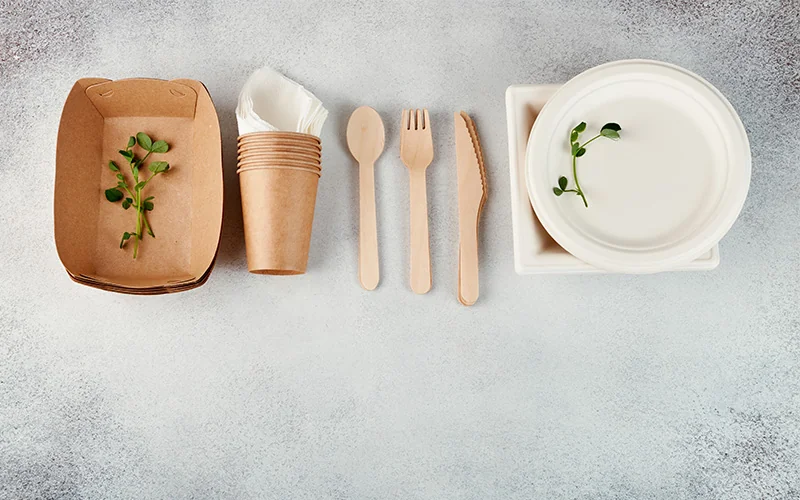
Paper cups often fall into this category. Many use a thin plastic or PLA lining to hold liquids. Because most recycling plants reject them, biodegradable paper cups make sense for short-term use where recycling or composting systems do not exist.
Biodegradable tablewares also fit low-risk use cases. For example, environmentally friendly utensils made from birch wood or bamboo fibers break down through microbial action. For you, this means they suit outdoor events, food trucks, or remote sites where waste handling stays basic.
You should also consider cost and supply stability. Biodegradable products often cost less than certified compostable items because they skip third-party testing like ASTM D6400. In other words, they offer a practical option when budgets matter more than strict waste diversion.
FAQs
Are compostable products better for the environment than biodegradable ones?
Yes. Compostable products meet defined standards for breakdown, while biodegradable products do not.
Compostable tableware is defined as material that breaks down into carbon dioxide, water, and biomass within a set time, often 90–180 days, under composting conditions. Because standards control this process, compostable items leave no toxic residue. For you, this means the product can return to soil as usable compost when handled correctly.
Biodegradable tableware only means the material can break down at some point. No rule sets a timeline or limits residue. In practice, this means some items may persist for years or break into microplastics instead of soil-safe material.
Can compostable tableware be processed in home composting systems?
Yes, but only if the product is certified for home composting.
Home-compostable tableware breaks down at lower temperatures, often below 30°C, which matches backyard compost piles. Because these systems lack high heat, only certain materials fully decompose. For you, this means you must check the label before placing items in your home compost.
Industrial-only compostable items need sustained heat around 55–70°C. In other words, they require commercial facilities. If you place them in home compost, they may stay intact for months.
What are the certifications to look for when purchasing compostable tableware?
You need to look for BPI Certification and EN 13432 (EU) and OK Compost.
BPI Certification (USA) verifies that products meet ASTM D6400 or D6868 standards. This confirms breakdown in industrial composting within a defined time. For you, this means facilities in the U.S. can accept the product without contamination risk.
EN 13432 (EU) and OK Compost confirm compostability under European standards. OK Compost HOME specifically tests low-temperature breakdown. In practice, these marks tell you whether the item works in home or industrial compost systems.