

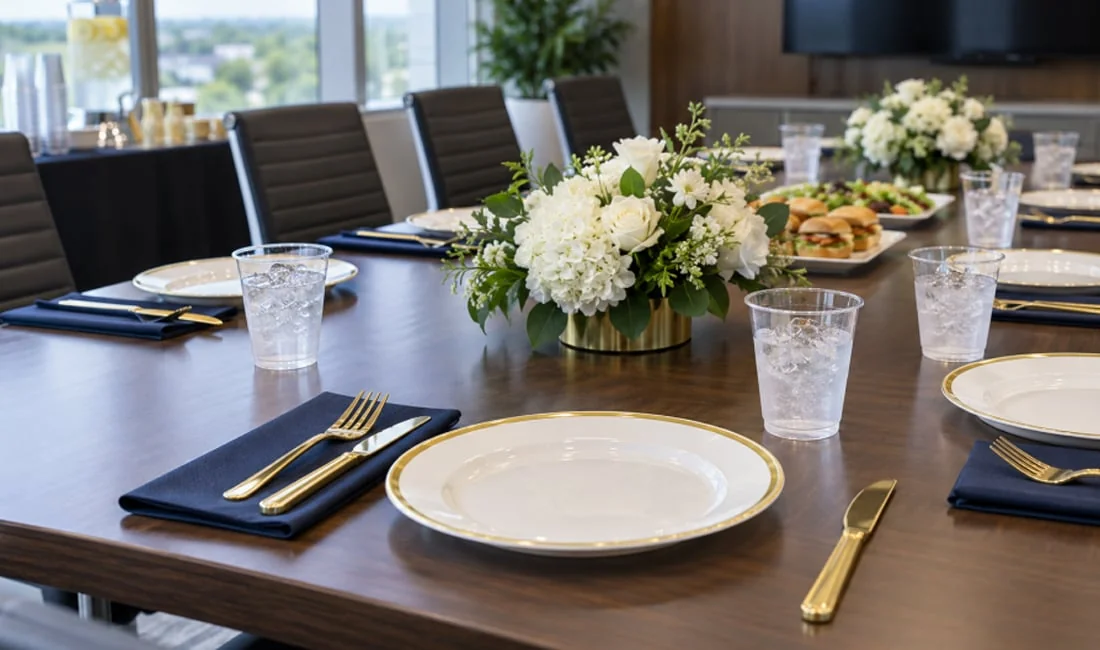
Corporate event disposable tableware should match the menu, service schedule, and expected attendance. A consistent finish matters, but so do plate strength, cup suitability, and the number of usable items in each pack.
For manufacturers and suppliers, a clear order starts with these details—not just a guest count. This guide explains how corporate buyers can select suitable products, calculate quantities, compare bulk orders, and create a professional table without adding items the event does not need.
Corporate Party Tableware Essentials by Event Type
The core order depends on how food and drinks will be served. Coffee breaks, team lunches, and client receptions each need a different product mix.
Coffee Breaks: Disposable Cups and Small Plates
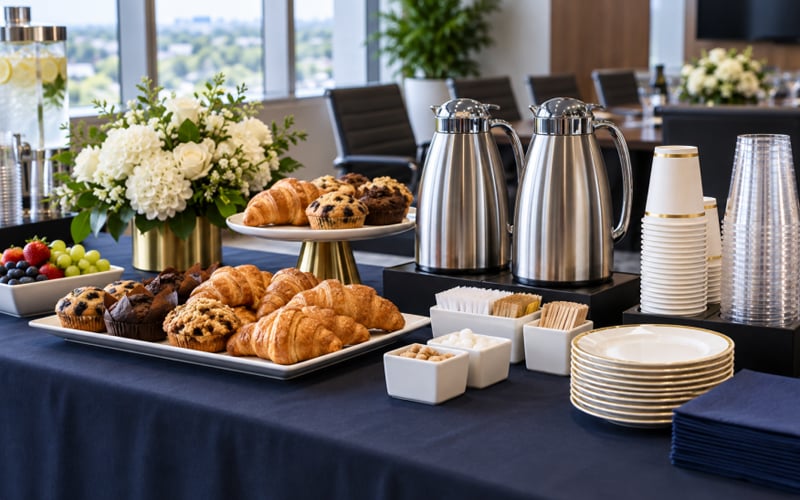
A coffee break needs cups intended for the drinks served, small plates for snacks, and napkins. Coffee, tea, and cocoa require products whose instructions allow hot-drink use. Cold-drink cups should be listed separately where water or juice is also served.
The order should state cup capacity and any need for sleeves or matching lids. Small plates can cover pastries, cookies, and other handheld snacks without adding a full dinner setting.
Team Lunches: Disposable Plates, Bowls, and Flatware
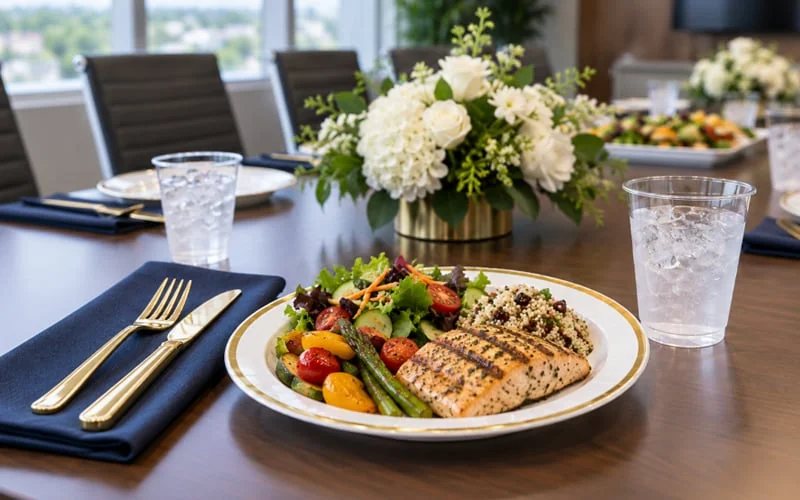
Lunch orders should follow the food, rather than include every type of tableware. A main meal may need dinner plates, forks, and knives. Soup requires suitable bowls and spoons, while a sandwich lunch may need fewer utensils.
Shared food also needs serving tools. These belong on a separate line in the buying list, so guest flatware is not mistaken for buffet equipment.
Client Receptions: Coordinated Dinnerware and Drinkware
A client reception benefits from a consistent finish across dinner plates, smaller plates, and flatware. The beverage menu should determine whether the order needs tumblers, wine glasses, or champagne flutes.
The supplier brief should describe both appearance and use. “White plates with gold rims for a seated dinner” gives a clearer direction than “elegant party supplies.”
How to Choose Disposable Tableware for Corporate Events
A suitable product must fit the food, the serving method, and the required pack count. Color alone is not enough to guide a bulk purchase.
Match Materials and Sizes to the Menu
Product details should include the material, size, and intended use. For plates, buyers should check the rim and usable food area as well as the overall diameter. For bowls and cups, capacity should suit the planned portion without filling the item to its edge.
The buying brief should also state any need for hot-food service, hot drinks, or reheating. These are separate uses that need product-specific confirmation. A decorative finish or a broad material label does not replace the manufacturer’s use instructions.
Check Stability for Seated and Standing Service
A sample check should reflect the actual meal. A plate can be loaded with the planned portion and checked for bending, leaks, or loss of shape over the expected serving time. Flatware can be tested with food that needs cutting or scooping.
For standing service, the check should also include carrying the loaded plate. A sample test helps assess handling; it does not establish heat resistance or replace the product’s stated limits.
Compare Complete Dinnerware Sets With Individual Packs
A dinnerware set is useful when its contents match the meal. The total piece count, however, is not the number of guests served.
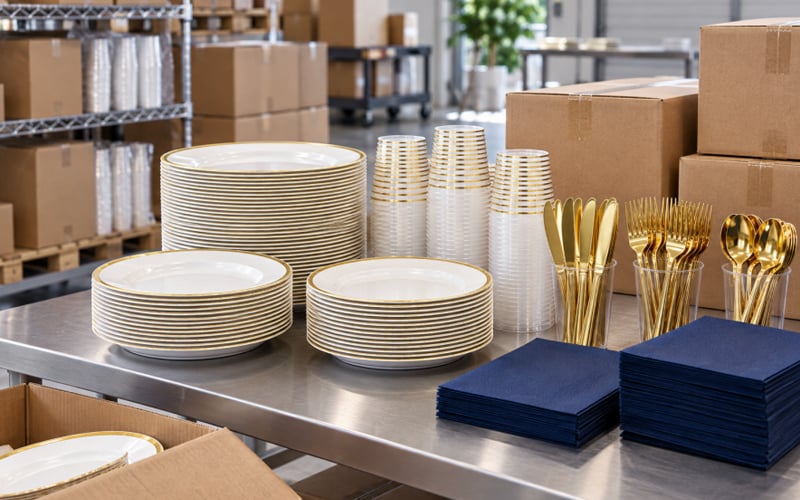
For example, the 175-piece white-and-gold dinnerware set contains 25 dinner plates and 25 salad plates. It also includes 25 each of knives, forks, spoons, cups, and napkins. That provides one of each included item for 25 guests.
Four such sets provide the same basic setting for 100 guests, before extras. Additional breaks or drink rounds still need their own quantities. Separate packs are worth comparing when a set would add utensils the menu does not require.
How Much Disposable Tableware Does a Corporate Event Need?
Quantities should be calculated for each meal and break, then combined by item. Counting only the people in the room can miss repeated demand for cups, small plates, and napkins.
Count Guests Separately for Each Meal and Break
Each service needs its own attendance figure, including speakers and staff who will eat.
The example below assumes 100 people at two snack breaks and one lunch. Snacks need no utensils, while lunch requires a fork and knife. Each person is allocated one hot-drink cup at each break and three cold-drink cups across the day. Soup and a separate dessert course are excluded.
|
Item |
Assumed use |
Base quantity |
With an illustrative 10% reserve |
|---|---|---|---|
|
Dinner plates |
One per person at lunch |
100 |
110 |
|
Small plates |
One per person at each break |
200 |
220 |
|
Hot-drink cups |
One per person at each break |
200 |
220 |
|
Cold-drink cups |
Three per person across the day |
300 |
330 |
|
Forks |
One per person at lunch |
100 |
110 |
|
Knives |
One per person at lunch |
100 |
110 |
|
Napkins |
One at each break, two at lunch |
400 |
440 |
These are example quantities, not standard usage rates. Lids, stirrers, serving tools, and other menu-specific items require separate counts.
Allow for Drink Changes and Replacement Pieces
Planned repeat use belongs in the base order. For example, morning coffee and afternoon tea require separate cup allowances even when the same guests attend both sessions.
An open drink station may also need a different estimate from one staffed serving round. Records from similar company events can help refine the count. A reserve should cover unexpected demand, not a known extra service.
Add a Practical Reserve and Round Up to Full Packs
The reserve should reflect attendance uncertainty and the chance of damaged, dropped, or replaced pieces. The 10% allowance above is only an example; it is not a fixed rule for every event.
Pack sizes determine the final purchase. For an item sold in packs of 50, a requirement of 110 pieces becomes three packs, or 150 pieces. That extra stock already contributes to the reserve and should not receive another blanket percentage on top.
Bulk Buying Corporate Tableware: Budget and Delivery
A bulk order offers value when it covers the full event at a reasonable delivered cost. A low price per piece is less useful when the pack contains the wrong mix.
Compare Delivered Costs for the Same Tableware List
Quotes should cover the same item quantities, sizes, finishes, and intended uses. The total should include delivery, applicable taxes, and any separate packs needed to complete the order.
The approval sheet can show the full cost and the cost per attendee. Extra spoons or cups have purchasing value only when a future use is planned and storage is available. Otherwise, the lower unit price may simply mean more unused stock.
Confirm Matching Stock Across All Required Items
The order should identify the exact product code, color, size, and pack count for each item. Suppliers should be asked to confirm availability across the whole list, rather than for dinner plates alone.
Acceptable substitutes should be agreed before payment. For a client dinner, the buyer may accept a different pack size but still require the same white-and-gold finish.
Allow Time for Internal Approval, Delivery, and Inspection
The buying schedule should work backward from the event’s setup date. It needs room for internal approval, order processing, shipping, inspection, and possible replacements.
A current delivery estimate for the actual order is more useful than a general promise. The delivery address, receiving hours, and named contact should be confirmed with the order. On arrival, the receiving team should check pack counts, sizes, colors, and visible damage against the approved list.
How to Make Corporate Disposable Tableware Look Professional
A professional table is easier to achieve with a repeatable layout and a limited color palette. Extra decoration is not a substitute for consistent products.
Pair Neutral Plates With Brand-Color Accents
A simple setting can combine white gold-rimmed disposable plates, clear cups, and navy napkins. The plate design supplies the main finish, while the napkins provide one clear accent color.
Brand colors can appear in napkins, table runners, or menu cards. This allows the company to change event details without changing every piece of dinnerware or relying on custom-printed products.
Keep Seated Place Settings Consistent and Uncluttered
Each seat should use the same layout and include only the pieces needed for that meal. A dessert plate can remain off the table when dessert will be served later at a separate station.
One sample setting, photographed before setup, gives staff a reference for spacing and placement. For meeting-room lunches, the layout should also leave room for notes and other work materials.
Arrange Buffet and Drink Stations for Easy Pickup
One practical buffet sequence is plates, food, then flatware and napkins. This lets guests collect utensils after filling their plates. A separate drink station is worth considering where the room allows it.
Short stacks can be topped up from nearby covered stock rather than placing the full order on display. Assigning one person to check supplies between sessions helps keep each station ready for the next group.
Lower-Waste Disposable Tableware for Office Events
Lower-waste purchasing begins with accurate quantities and a disposal plan that matches the venue. Material claims should support that plan, not replace it.
Check Compostability Claims and Local Collection Options
A compostability claim needs evidence for the finished product and clear disposal conditions. Supplier documents should identify the exact product covered. Broad terms such as “green” or “eco-friendly” do not provide the same information.
Commercially compostable tableware also needs a local collection program and a facility that accepts the items. A compostability label alone does not confirm that the venue’s waste contractor can handle them.
Compostable plastics should not go into conventional plastic recycling. Other plastic plates and cups should enter the recycling stream only where the local program accepts those items and according to its sorting instructions.
Keep Unused Packs Sealed for Future Meetings
Opening stock in stages helps preserve unused packs for later events. Sealed packs should remain in clean, dry storage under the manufacturer’s stated conditions.
The closing inventory should record each item’s code, style, and remaining quantity. The next purchase can then account for existing stock. This is more useful than ordering another complete set simply because a new meeting is scheduled.
FAQs About Corporate Event Disposable Tableware
Who Supplies Tableware When a Caterer Is Booked?
The catering agreement should identify which party supplies each item. Dinner plates, guest utensils, and cups should be checked separately from serving trays and buffet tools. The agreement should also state who receives deliveries, sets up the tableware, and provides backup stock.
Can Disposable Dinnerware Be Mixed With Rented Glassware?
Yes, where the venue permits that combination. Disposable plates can be paired with rented glasses in a matching style. The service team needs a separate return point for the rental items, so they are not discarded during cleanup.
How Should Tableware Be Packed for Events at Multiple Offices?
Each office needs an allocation based on its own attendance and service schedule. Sealed packs can be grouped by location and labeled with the item count, event date, and recipient. Each site should have its own reserve rather than depend on spare stock held elsewhere.
Create a Consistent Corporate Table With Wonderful Party
A useful corporate tableware order balances suitable products, clear quantities, and a consistent finish. The aim is to support every meal and break without paying for pieces that have no planned use.
A practical next step is to compare Wonderful Party’s coordinated sets and individual packs against the approved event list. The order can then be completed with the right quantities for the main meal, each break, and backup stock.