


Every plastic plate, cup, and drinkware item carries a small triangular symbol stamped somewhere on its surface — usually on the bottom. Inside that triangle sits a number, ranging from 1 to 7. Most people assume the triangle itself means “recyclable,” but that assumption is one of the most widespread misunderstandings in consumer waste management. The triangle is a Resin Identification Code, and the number inside identifies only the type of plastic — not whether the item can actually be recycled in any given municipality. For event planners and hosts managing the aftermath of a party, understanding what these numbers mean is the difference between effective sorting and contaminating an entire recycling load with materials the local facility cannot process. This guide decodes each number, identifies which codes appear most frequently on disposable party tableware, and provides a practical sorting process for after the last guest leaves.
What Are Plastic Recycling Codes?
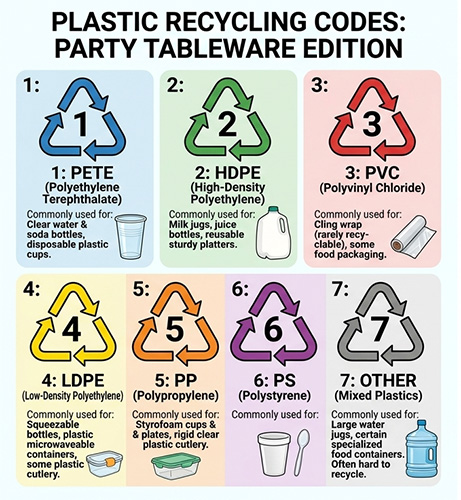
Plastic recycling codes are the numbered symbols — officially called Resin Identification Codes (RICs) — printed inside the triangular chasing arrows icon on plastic products, identifying the specific type of polymer resin used in manufacturing so that consumers and recycling facilities can categorize each item into the correct waste stream. The system was introduced in 1988 by the Society of the Plastics Industry and is now managed by ASTM International.
The chasing arrows triangle is one of the most misunderstood icons in consumer packaging. Its presence does not confirm that a product is recyclable — it confirms only what the product is made of. Whether that material is actually accepted for recycling depends entirely on the local facility’s equipment, processing capabilities, and current market conditions for that specific resin type. Two identical-looking plastic cups carrying different numbers may have completely different disposal fates in the same city.
Why Do Resin Identification Numbers Matter When Sorting Disposable Party Tableware?
Resin identification numbers matter because they determine whether each piece of plastic tableware can enter the local recycling stream, needs to go to general trash, or — if misidentified — risks contaminating an entire batch of otherwise recyclable material.
Parties generate a concentrated burst of disposable plastic waste. A single event for 40 guests can produce dozens of plates, cups, and drinkware items in a few hours. If all of these items are swept into a recycling bin without checking their codes, materials that the local facility cannot process will contaminate the load. Different resin types require different processing temperatures and methods — mixing incompatible types degrades the quality of the recycled output and can cause entire batches to be rejected. The most damaging example involves PLA (a plant-based plastic marked #7) entering a PET (#1) recycling stream. The two materials appear nearly identical to the naked eye, but PLA contaminates PET processing, potentially rendering the full batch unusable.
Which Numbered Plastics Are Most Common in Disposable Party Tableware and How Recyclable Is Each?
The resin codes most frequently found on disposable party tableware are #5 (PP), #6 (PS), and #1 (PET), with each offering a different level of recyclability and structural performance in event settings.
Why Is #5 Polypropylene the Most Widely Used Resin in Premium Plastic Plates and Cups?
Polypropylene (#5 PP) is the most widely used resin in premium disposable tableware because it offers an optimal combination of rigidity, heat resistance, and food-contact safety. PP does not bend or sag under hot foods, resists grease penetration, and is considered one of the safest food-contact plastics — free of BPA and other known chemical leaching concerns. These properties make PP the material of choice for high-quality disposable plates and party cups designed to handle full meals rather than just light snacks. From a recycling standpoint, PP acceptance is expanding steadily across North America. An increasing number of municipal curbside programs now include #5 in their accepted materials list, though coverage is not yet universal. Hosts should verify local acceptance before placing PP tableware in a recycling bin.
Where Does #6 Polystyrene Appear in Lightweight Party Drinkware and Cutlery?
Polystyrene (#6 PS) appears in two forms in party supplies: rigid solid PS, used for lightweight transparent cups and some cutlery, and expanded polystyrene (EPS), commonly known as foam. Rigid PS offers clarity and low cost but is more brittle than PP and provides less structural support for heavy or hot foods. The recycling outlook for PS is significantly less favorable than for PP. Most North American curbside recycling programs do not accept #6 plastics, and polystyrene has been estimated to account for a substantial portion of landfill material in the United States. The light, brittle nature of PS also creates mechanical problems at sorting facilities, where it can fragment and contaminate other material streams during processing.
How Is #1 PET Used in Clear Party Drinkware and Why Is It Easily Recycled?
Polyethylene terephthalate (#1 PET) is used for clear, glass-like party drinkware — particularly transparent cold-beverage cups, and certain styles of plastic wine glasses and champagne flutes where visual clarity is a priority. PET is the most widely recycled plastic in North America, accepted by virtually all curbside programs. Its high market value and well-established processing infrastructure make it one of the most reliably recyclable materials at any party. The key requirement is that PET items must be empty, rinsed of residual liquids, and free of heavy food contamination before entering the recycling bin.
Why Are Codes 2, 3, 4, and 7 Rarely Found on Disposable Event Tableware?
Codes #2 (HDPE), #3 (PVC), #4 (LDPE), and #7 (Other) rarely appear on disposable party tableware because their physical properties do not align well with dinnerware and drinkware applications. HDPE is primarily used for bottles and jugs rather than flat tableware. PVC is almost never used in food-contact disposables. LDPE is a soft, flexible plastic found in bags and wraps — occasionally in disposable tablecloths but not in rigid tableware. Code #7 is a catch-all category covering miscellaneous plastics, including polycarbonate and PLA. PLA is the most important #7 variant for party hosts to recognize — it is a plant-based compostable plastic that looks identical to PET but must never enter a recycling bin. PLA contaminating a PET recycling stream can cause the entire batch to be downgraded or rejected.
Why Does Product Shape Affect Whether Coded Party Tableware Actually Gets Recycled?
Product shape affects recycling success because the mechanical sorting equipment at Material Recovery Facilities (MRFs) is primarily designed to identify and sort three-dimensional containers like bottles and jugs, not flat or shallow items like plates and cups.
Optical sorters at MRFs use infrared sensors to detect resin types and blow items into the correct processing lanes. These systems perform best with objects that have depth and volume — a water bottle or yogurt tub presents a recognizable profile. A flat disposable plate, by contrast, can be misread as paper or cardboard by the sorting equipment, or may slip through conveyor gaps and end up in the wrong stream. Lightweight cups face a similar challenge. This means that even when a party plate carries a locally accepted resin code like #5 PP, its flat shape gives it a lower probability of successful sorting compared to a PP food container of the same material. Awareness of this limitation helps hosts set realistic expectations — code-based sorting maximizes the chance of recycling but does not guarantee it for every item.
How Does Food Contamination Affect the Recyclability of Labeled Disposable Dinnerware?
Food contamination can disqualify otherwise recyclable disposable dinnerware from the recycling stream, because grease, sauces, and food residue degrade the quality of recycled plastic output and can cause processing facilities to reject contaminated batches.
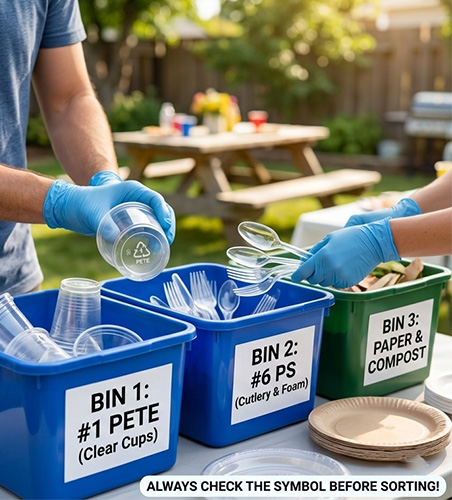
The distinction between acceptable and disqualifying contamination is practical, not absolute. A plate with a few crumbs or a light residue that can be removed with a quick rinse or wipe is still recyclable. A plate saturated with oil, caked with dried sauce, or carrying substantial food remains should be placed in general trash. The reason is economic as much as technical — contaminated material lowers the market value of the recycled output, and facilities operating on tight margins will reject loads that exceed their contamination thresholds rather than invest additional cleaning resources. At a post-party sorting station, the most effective workflow is to scrape all food scraps into a compost or trash bin first, pour out remaining liquids from cups, then give each item a brief rinse before checking its resin code and sorting accordingly.
What Are the Advantages and Disadvantages of Sorting Event Supplies by Recycling Symbol?
Sorting event supplies by recycling symbol offers clear waste management benefits but also presents practical challenges that hosts should anticipate.
What Benefits Does Code-Based Sorting Provide for Post-Party Cleanup?
The primary benefit of code-based sorting is precision — resin identification numbers replace guesswork with objective material data, enabling hosts to match each item directly to the local recycling facility’s acceptance list. This approach maximizes the proportion of party waste that actually enters the recycling stream rather than ending up in a landfill. It also prevents the costly mistake of “wishful recycling,” where uncertain items are tossed into the recycling bin on the assumption that the facility will sort them out. Wishful recycling introduces contaminants that can compromise entire loads of clean recyclable material, making informed code-based sorting a net positive for both the household and the broader waste system.
What Practical Challenges Make Symbol-Based Sorting Difficult at Events?
The main challenge is visibility — resin codes are often small, embossed rather than printed, and located on the underside of items where food residue may obscure them. In low-light outdoor party settings, reading these codes becomes even harder. Guest compliance is another barrier, as most attendees will not check the bottom of a cup before discarding it. Additionally, a single event may feature three or four different resin types across its tableware — plates in PP, clear cups in PS, drinkware in PET — requiring item-by-item inspection during cleanup. Regional variation in recycling rules adds further complexity, as a resin code accepted in one city may be rejected in another just miles away.
How Should Hosts Sort Numbered Disposable Tableware After a Party?
The most effective sorting approach begins before the party starts, by confirming which resin codes the local recycling program accepts and then setting up the event with that information in mind.
What Pre-Party Preparation Makes Recycling Code Sorting Easier?
Pre-party preparation should start with a visit to the local waste hauler’s website or a quick phone call to confirm which plastic numbers are accepted curbside. In most North American communities, #1 and #2 are universally accepted, #5 is increasingly accepted, and #6 and #7 are typically excluded. Checking the bottom of purchased tableware and kitchen supplies before the event reveals what resin types are in play — this takes less than a minute and prevents confusion later. At the sorting station, signage should list specific accepted codes (such as “Clean #1 and #5 Plastics Only”) rather than a generic “Recyclables” label, giving guests and post-party sorters clear, actionable guidance.
What Step-by-Step Process Works Best for Sorting After the Last Guest Leaves?
A five-step sorting process delivers the best results after an event. First, scrape all food remains off plates and out of cups into a compost or trash receptacle — food should be separated from tableware before any recycling decision is made. Second, pour all remaining liquids out of cups and drinkware, as liquid is one of the most common sources of recycling contamination. Third, give each plastic item a quick rinse or wipe to remove surface residue. Fourth, flip each piece over and group items by the resin number on the bottom. Fifth, place items with locally accepted codes into the recycling bin and route all others — including any items without a visible code — into general trash. When in doubt about a particular item, choosing trash over recycling is always the safer decision, because one misplaced item in a recycling bin causes more systemic harm than one recyclable item in a trash bag.
FAQs
Does the chasing arrows triangle on a plastic cup guarantee that it is recyclable?
The chasing arrows triangle does not guarantee recyclability. It is a Resin Identification Code that identifies the type of plastic resin used in manufacturing. Whether that resin is accepted for recycling depends on the local facility’s capabilities and current material acceptance list. A product carrying the triangle and a #6 code, for example, will be rejected by most curbside recycling programs in North America.
Can different numbered plastics from the same party be combined in one recycling bin?
In single-stream recycling systems — the most common model in North America — all locally accepted resin numbers can be placed in the same bin. The Material Recovery Facility uses optical sensors, air jets, and manual sorting to separate different resin types mechanically. However, resin codes that the local program does not accept should never be included, even if mixed with accepted codes, as they become contaminants within the sorting system.
What is the most recyclable plastic type commonly used in premium disposable tableware?
Polypropylene (#5 PP) is the most common resin in premium disposable party tableware, and its recycling acceptance across North American municipalities is expanding steadily. PP combines high structural performance — heat resistance, rigidity, food-contact safety — with a growing recycling infrastructure. That said, hosts should always confirm #5 acceptance with their specific local program before placing PP tableware in a recycling bin.