

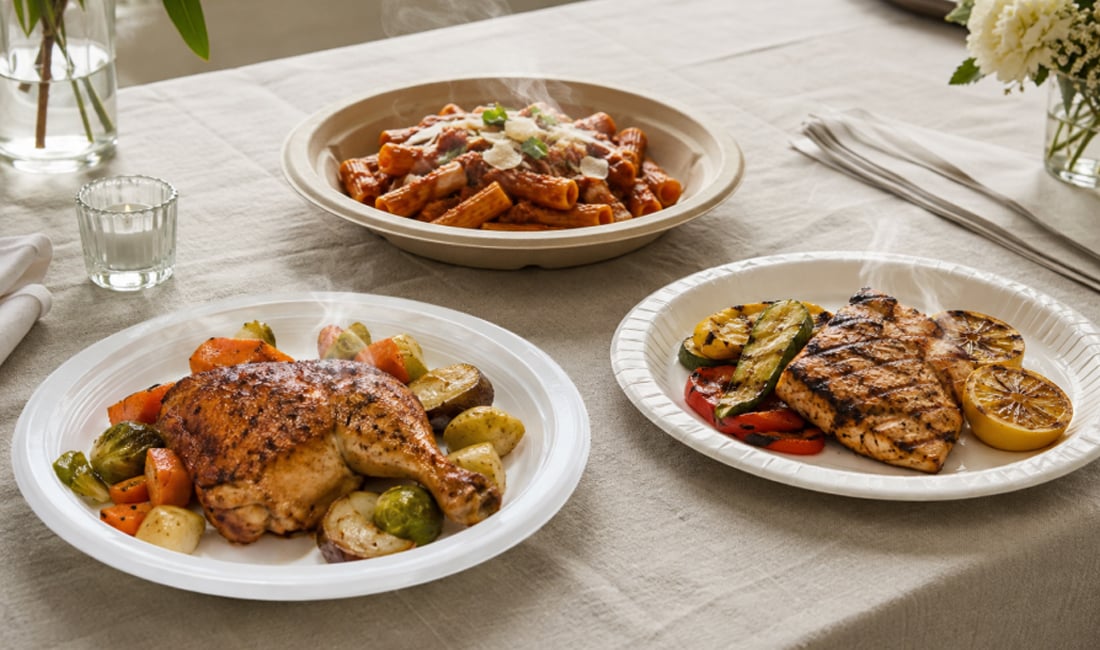
The best disposable plates for hot food are usually made from polypropylene (PP), molded fiber, or heavyweight coated paper. They must also suit the actual food and service conditions. There is an important limit. A material name alone does not prove that a finished plate can handle a steaming entrée, a long buffet, or microwave reheating.
Heat performance depends on food temperature, contact time, moisture, oil, portion weight, plate thickness, and any coating or decoration. A plate that carries warm pizza for 15 minutes may not hold saucy pasta for an hour. A plate that serves hot food safely may still be unsuitable for the microwave, oven, broiler, or grill.
This guide compares the main materials used for heat-resistant disposable plates. It also explains the numbers behind common temperature claims. Most of all, it shows buyers how to match a plate to a real menu rather than a vague label.
What Makes a Disposable Plate Heat-Resistant?
Heat resistance is not one property. A useful hot-food plate must keep its shape and support the meal. It also needs to resist grease and moisture. Its food-contact documents must cover the stated time and temperature.
Serving Hot Food Is Different From Reheating It
Serving and reheating expose a plate to different conditions. When roast chicken moves from a pan to a plate, the food begins to cool. In a microwave, the food keeps heating. It may develop hot spots or release steam. Very hot oil and sugar may also touch the plate.
The same distinction applies to an oven. Microwave energy heats food differently from the hot air and radiant heat in a conventional oven. A microwave-safe claim does not establish oven safety. A hot-food claim does not establish either one.
For purchasing purposes, three questions should be kept separate:
• Can the plate serve the food at its highest plating temperature?
• Can it hold that food for the full meal, delivery, or buffet period?
• Can the plate be used in a microwave or oven under stated instructions?
Temperature, Contact Time, and Food Type Work Together
A temperature number is useful only when it comes with a time and food type. A plate may tolerate brief contact with a hot, dry sandwich. The same plate may soften under curry or gravy over a longer period, even at a lower temperature.
Food regulators use the same basic logic. The FDA’s food-contact conditions of use separate hot filling above and below 150°F (66°C). They also separate boiling-water contact, reheating in a container, and cooking above 250°F (121°C). These are regulatory categories, not automatic plate ratings. Still, they show why “food-safe” is incomplete without an intended temperature and use.
Hot, fatty, acidic, or wet foods may also require different food-contact documentation. Buyers should ask whether the supplier’s support covers the actual menu, not merely dry food at room temperature.
The Finished Plate Matters More Than the Material Name
Two plates made from the same resin or fiber can perform very differently. Thickness and fiber density can change the result. So can fillers, forming pressure, ribs, rim shape, laminates, grease barriers, adhesives, and print.
This is why resin data cannot replace a finished-product specification. Polypropylene may be a strong starting point for hot food, but an extremely thin PP plate can still flex. Molded fiber may resist high heat, but an unlined plate can gradually absorb liquid. A paperboard plate may feel rigid while dry and lose strength after sitting under gravy.
The correct unit of evaluation is the complete plate in its intended use—not the raw material in isolation.
Which Disposable Plate Materials Handle Hot Food Best?
PP and quality molded fiber offer the broadest potential for demanding hot-food service. Heavyweight coated paper is often practical for shorter meals. PS, PET, palm leaf, wood, and bioplastics need a closer look at the exact grade and product claim.
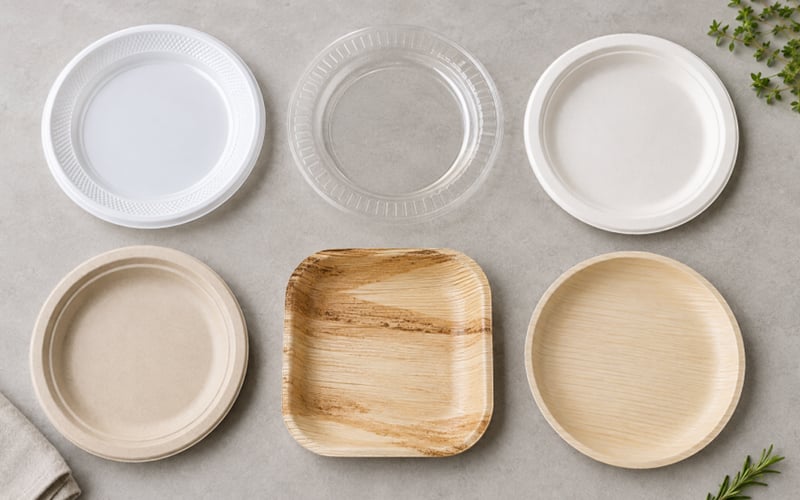
Heat-Resistant Disposable Plates Comparison Table
The table below is a selection guide, not a substitute for a supplier’s instructions. Where numbers appear, they are examples from published commercial foodware specifications. There are not universal limits for every plate made from that material.
|
Material |
Typical temperature tolerance to verify |
Best hot-food uses |
Wet or oily performance |
Microwave? |
Oven? |
Main limitation |
|---|---|---|---|---|---|---|
|
Polypropylene (PP) |
Product-specific; some commercial PP foodware is rated to 230°F (110°C) |
Hot entrées, sauced foods, takeout, short reheating when labeled |
Usually good in a suitable grade and thickness |
Only a labeled SKU |
Not by default |
Thin plates may flex; additives and decoration affect the claim |
|
Polystyrene (PS/XPS) |
Product-specific; published PS plate examples reach about 203–212°F (95–100°C) |
Short service of warm or hot food when approved |
Varies; foam and rigid PS behave differently |
Generally no unless expressly stated |
No |
Can soften, warp, or crack; material identity is often unclear |
|
PET or RPET |
Many commercial food-container examples list about 151°F (66°C) as a maximum |
Cold, room-temperature, or mildly warm presentation |
Often good for cold wet foods |
No by default |
No; CPET ovenware is a separate product class |
Clear appearance can be mistaken for heat resistance |
|
Heavyweight or coated paper |
No universal range; confirm the board, coating, and contact time |
Pizza, sandwiches, baked foods, and plated meals of limited duration |
Moderate to good with the right barrier |
Only when labeled; plain white unprinted paper is the cautious choice |
Only specially designed ovenable board |
Steam, sauce, and grease can reduce strength over time |
|
Bagasse or molded fiber |
Product-specific; some commercial lines state hot-food use up to 450°F (232°C), often with time limits |
Curries, rice dishes, barbecue, buffets, and compartment meals |
Usually good when properly formed or lined |
Some products allow short use; check instructions |
Some products allow limited oven use |
Performance varies by fiber blend, lining, thickness, and hold time |
|
Palm leaf or wood |
No universal ceiling; use a supplier’s hot-food rating |
Hot, fairly dry or moderately oily plated foods |
Often good for short service; natural variation occurs |
Only if expressly permitted |
No by default |
Irregular thickness, seams, or grain can affect consistency |
|
PLA and other bioplastics |
Grade-specific; standard clear PLA is commonly intended for cool or cold service |
Salads, fruit, desserts; hot use only for a heat-modified and rated product |
Can be good within the intended temperature range |
No by default |
No by default |
“Plant-based” or “compostable” does not mean heat-resistant |
Published specifications help put these ranges in context. Dart lists 230°F for one PP food container. It lists 203°F for one PS plate and 151°F for one PET container. These examples show how much the ranges can differ. Their limits should not be copied onto another supplier’s plate.
Polypropylene (PP) Disposable Plates
PP is often the strongest all-around plastic candidate for hot meals. A well-made PP plate can resist heat and moisture while keeping some flexibility. That helps it carry sauced food without the brittle feel of some other rigid plastics.
It is also widely used in microwaveable food containers. However, that does not make every PP plate microwave-safe. A plate’s thickness, pigments, fillers, decorative layers, and manufacturing quality still matter. The microwave claim must apply to the finished plate. Its package or technical sheet should also state any time, power, and temperature limits.
PP is a practical material to investigate for hot pasta, rice, meat, vegetables, and catering portions. Buyers should still ask for the resin type and maximum service temperature. They also need the contact time and microwave statement for the exact SKU.
Polystyrene (PS) and PET Disposable Plates
PS and PET are often grouped together as “plastic,” but their typical uses differ. Rigid PS can produce crisp shapes and an elegant finish. Expanded PS foam provides insulation and low weight. Some commercial PS plates are approved for hot and cold use. Even so, PS is not the automatic choice for microwave reheating or long contact with very hot, oily food.
PET is valued for clarity, stiffness, and cold-food presentation. Standard PET foodware is commonly selected for salads, desserts, fruit, and chilled displays. Clear PET can look substantial while still having a lower recommended service temperature than microwaveable PP.
CPET trays are made for higher-heat uses. However, “PET” on a generic disposable plate does not mean CPET. Buyers should not infer oven or microwave use from clarity, thickness, or a recycling code alone.
Heavyweight Paper and Coated Paper Plates
Paper plates can work well for hot food. The meal should not be too wet, and the service time should be controlled. Heavy paperboard, molded edges, and grease barriers improve stiffness and reduce soak-through. These plates are common for pizza, sandwiches, pastries, grilled items, and casual buffet meals.
Their weakness is usually not immediate heat alone. Steam, sauce, oil, and time gradually affect the fibers. A plate may feel stable during a five-minute sample test. It may still sag after a guest carries it around a reception for 30 minutes.
Coatings also change the answer. A water-based barrier, polymer lining, laminate, printed surface, or adhesive may have its own use limits. “Paper” should therefore be treated as a construction category, not a single temperature rating.
Bagasse and Molded-Fiber Plates
Bagasse plates are formed from sugarcane fiber, often blended with other plant fibers. Their dense, three-dimensional structure usually gives them better wet strength and heat performance than thin flat paper plates. They are a strong candidate for rice dishes, barbecue, vegetables, curry, and other substantial meals.
Some finished molded-fiber products carry clear microwave and oven claims. For example, World Centric says its fiber plates suit hot or cold food and short microwave or oven use. Its broader guidance gives separate microwave time limits for lined and unlined fiber products. This evidence applies to those products. It is not a blanket rule for every bagasse plate.
Fiber blend, forming pressure, wall thickness, lining, and grease barrier all matter. A buyer should also check each environmental statement on the finished product. Examples include “no added PFAS” and compostability. These claims can be useful, but they do not replace a hot-food specification.
Palm Leaf and Wood Plates
Palm-leaf and wood plates bring natural texture and a rigid feel to catered events. Well-made versions are sold for both hot and cold food. They can handle many grilled, baked, or moderately oily dishes during normal meal service.
Natural materials vary more visibly than uniform plastic. Thickness, grain, pressed shape, edge finish, and any joining method can affect stability. Very wet food may also expose seams or thinner areas over time.
These plates are best checked as individual products. Buyers should ask about hot-food contact and the maximum hold time. They should also ask about microwave use and any coating, glue, or treatment.
PLA and Other Bioplastic Plates
PLA is a plant-derived plastic used for many clear cold cups, lids, and deli containers. Standard PLA is not a sound choice for high heat. CPLA, or crystallized PLA, is made to resist more heat. It appears in some hot-food items, but the letters alone do not prove a finished plate’s rating.
The practical lesson is simple: compostable and heat-resistant are separate claims. The same is true of biodegradable, BPA-free, and PFAS-free. None of those terms confirms microwave or oven use.
Before ordering bioplastic plates for hot meals, a buyer should get the exact polymer or blend. The file should state the service temperature, contact time, and appliance instructions.
What Changes the Heat Performance of Disposable Plates?
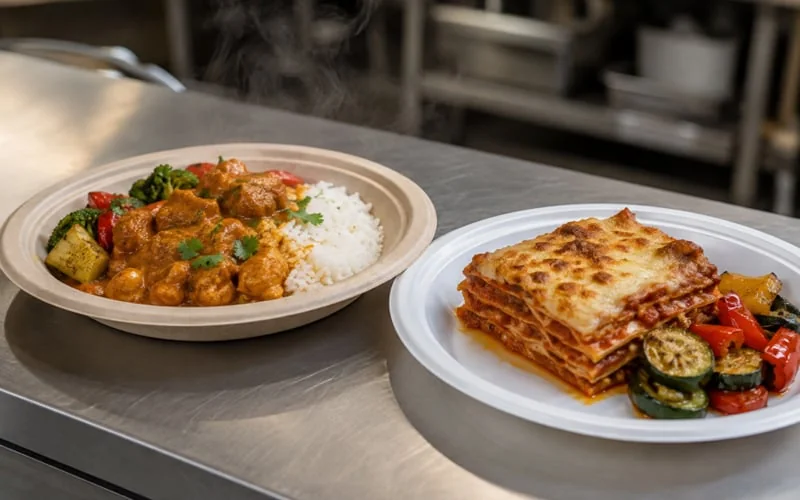
Material selection creates a starting point. The meal and service plan determine whether the plate succeeds in practice.
Hot Oil and Sugar Create More Heat Stress
Water-rich food tends to stay near the boiling point of water under normal cooking conditions. Oil and concentrated sugar can become much hotter. Fried food, caramel, cheese, and oily sauces may create small hot spots. The rest of the meal may be cooler.
Fat also acts differently on food-contact materials than water does. Documents for dry or water-based food may not cover fatty food at the same heat. This is one reason buyers should give suppliers a sample menu. Asking only for “hot plates” is not enough.
Moisture and Sauce Reduce Strength Over Time
Steam and liquid can enter paper or fiber structures, mainly at cut edges and thin areas. The plate may soften as the fibers absorb moisture. It may bend more easily or let sauce reach the outer surface.
Good forming and an appropriate barrier can slow this process, but time remains important. Soup-like dishes, gravy, salsa, curry, and juicy proteins should be tested for the full expected holding period. A short demonstration immediately after plating is not enough for delivery or buffet use.
Heavy Portions Stress Thin Plates and Flat Rims
Heat can make a marginal plate feel weaker, but portion weight is often the force that exposes the problem. A large serving of meat, sides, and sauce places more bending stress on the center than a light dessert.
Thicker walls, ribs, raised rims, and a well-supported base can improve handling. A deeper rim also contains liquid when a guest walks or eats while standing. Plate diameter should match the meal. An oversized plate may flex when food sits only in the center. A well-sized plate spreads the load more evenly.
A two-size heavy-duty plastic plate set can simplify dinner-and-dessert planning. Before using it with demanding hot food, buyers still need the material and temperature instructions for that exact item.
Coatings, Inks, and Metallic Accents Change Performance
A disposable plate is more than its base sheet or resin. The FDA explains that food-contact substances can include coatings, adhesives, and colorants. They also include the package material itself. Each part must suit its intended use.
Some printed surfaces keep ink away from food. Laminates and barriers may control grease or moisture. Decorative gold or silver accents can add metal-containing layers that rule out microwave use. A supplier’s statement should cover the decorated finished plate, not just the plain base material.
Can Heat-Resistant Disposable Plates Go in the Microwave or Oven?
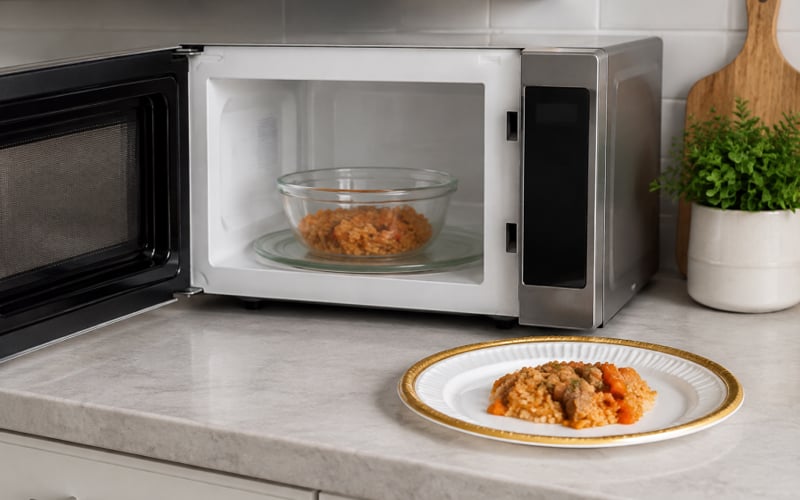
Only plates with clear appliance instructions should be used for reheating. Heat-resistant serviceware and microwave cookware are overlapping categories, not identical ones.
Check Microwave-Safe Labels and Heating Limits
The safest purchasing rule is to require a clear microwave-safe statement for the exact SKU. The label or technical sheet should state any limits on power, time, food type, or number of heating cycles.
The USDA advises using utensils labeled for microwave use. It also notes that most paper plates can be used and prefers white, unprinted paper. Buyers should not extend that advice to every paper plate. Coated, laminated, bright, or metallic plates need a product-specific statement.
Even a microwave-safe plate can become hot because heat moves from the food. Users should handle it with care. Heating should stop if the plate warps, smells odd, develops soft spots, or shows surface damage.
Keep Metallic Accents and Unlabeled Plates Out of the Microwave
Gold rims, silver bands, foil stamping, and other metallic effects should stay out of the microwave. The only exception is a clear statement from the maker. The FDA’s microwave guidance explains that metal usually reflects microwave energy. This can lead to uneven cooking or damage the oven.
Unlabeled plastic should also be treated as serving ware only. A plate may carry hot food without bending. That does not show how it will react while the food keeps heating.
Treat Oven, Broiler, and Grill Use as Separate Claims
A conventional oven surrounds the plate with steady hot air and radiant heat. A broiler adds strong heat from above. A grill or hot plate may bring the plate into direct contact with a much hotter surface. These conditions are more severe than carrying a cooked meal to the table.
Most ordinary disposable plastic and paper plates should stay out of ovens and broilers. They should also stay off grills, flames, and hot plates. The exception is a finished product made for that appliance, temperature, and duration. “Microwave-safe” does not create that permission.
Transfer Food When the Plate’s Rating Is Unclear
When the label is missing or unclear, move the food to known microwave- or oven-safe cookware. After reheating, transfer the meal to the disposable plate for serving.
This extra step is faster and less costly than guessing. It matters most when an event uses plates from several cartons. Staff instructions should explain the difference between serving and reheating before service begins.
How to Choose Heat-Resistant Disposable Plates for Hot Food
The best buying process starts with the menu and works backward. It does not begin with a material trend or a claim such as “heavy-duty.”
Match the Plate to the Hottest and Wettest Menu Item
List every dish that will touch the plate. Then find the item with the toughest mix of heat, oil, moisture, acid, and contact time. Lasagna with sauce may control the decision even if most of the menu is dry. A hot dessert with syrup may create a different challenge from grilled meat.
Give the supplier the expected plating temperature and the longest likely hold time. If those values are unknown, measure them during a kitchen trial. Do not rely only on cooking temperature or a phrase such as “served hot.”
Choose Enough Rigidity, Rim Depth, and Plate Size
Judge rigidity while the plate is warm and loaded, not while it is empty. The center should resist folding. The rim should offer a firm grip without bringing a hand too close to hot food.
Deep rims suit sauced meals and standing receptions. Flat plates may present appetizers or desserts more attractively. A 10-inch dinner plate offers room for a full entrée. A smaller plate can reduce flex and waste for desserts, salads, or tasting portions.
After heat performance is confirmed, disposable dinnerware sets can make planning and styling easier. Buyers should still check each item in the set. One plate’s rating does not apply to every component.
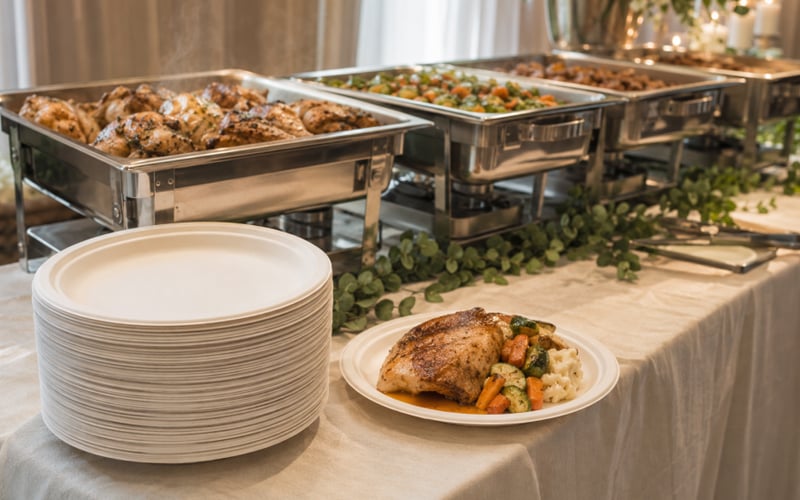
Account for Contact Time, Transport, and Buffet Holding
A plated meal served at once creates less exposure than food packed for delivery. Closed transport can trap steam. Stacked plates may also transfer heat and press on the lower items. Buffet food may stay hot before plating, but guests may carry full plates for a long time.
The test plan should mirror these details. If an event includes a 20-minute drive, test the packed meal for at least that long. Guests may also leave a plate on the table before getting seconds. Include that time when testing leftover sauce.
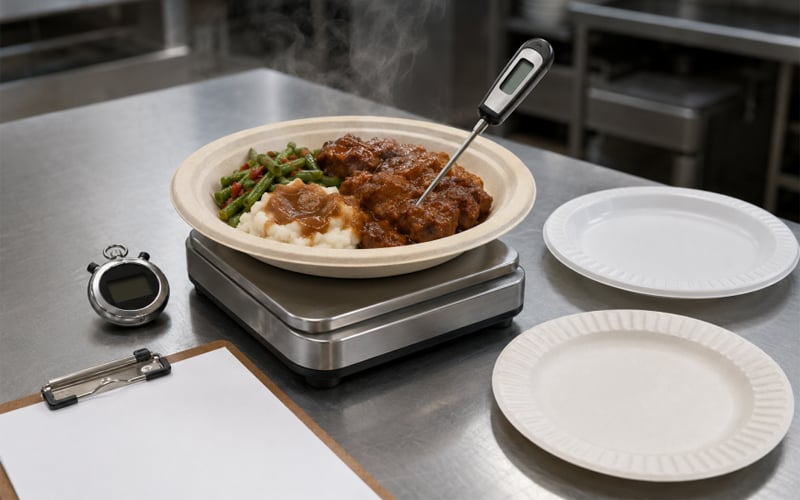
Test Samples With the Actual Food and Service Conditions
A useful sample test uses the real menu and portion weight. It also uses the highest plating temperature and expected hold time. Staff should lift the plate by one side, carry it, and cut food on it. They should check the base for heat, grease marks, soft spots, leaks, cracks, or odor.
For microwave-approved products, follow the supplier’s limits. Test the intended portion in the actual equipment. Microwave power and food content can change the result. Record the SKU, lot, test conditions, and outcome so the purchasing team can repeat the decision.
Verify Food-Contact and Heat-Use Documentation
For large orders or commercial service, request documents before final approval. A practical supplier file may include:
The base material and any lining, coating, laminate, ink, or adhesive relevant to food contact
• A statement of compliance for the target market and intended food-contact conditions
• The maximum recommended food temperature and permitted contact time
• Microwave, oven, freezer, and hot-holding instructions stated separately
• Relevant finished-product test reports or migration support
• Manufacturing lot identification and a process for handling specification changes
• Environmental claims, such as compostable or no added PFAS, supported separately from heat claims
In the United States, “FDA approved plate” is often an imprecise phrase. Buyers should ask what supports each part and intended use. The answer may cite a rule, a prior sanction, or an effective Food Contact Notification. The FDA notes that a finished material’s status depends on each substance it contains.
Frequently Asked Questions About Heat-Resistant Disposable Plates
These short answers cover the decisions buyers and hosts most often need to make before serving hot meals.
What Are the Best Disposable Plates for Hot Food?
PP and quality molded-fiber plates are often the best starting points for very hot, wet, or oily food. Heavyweight coated paper can work well for shorter service and drier menus. Base the final choice on the exact plate’s stated temperature and contact time. Food type and appliance instructions also matter.
Can Plastic Disposable Plates Hold Hot Food?
Some can, but “plastic” is too broad to answer the question. PP often suits hotter uses than standard PET. PS performance depends on its form and product design. Treat an unlabeled decorative plate as serving ware only. Confirm the resin and finished-product rating.
Are Paper Plates Safe for Hot and Oily Food?
Some heavyweight or coated paper plates are made for hot and oily food. Thin or uncoated plates may absorb grease, soften, or sag over time. Check the coating, maximum temperature, and permitted duration. Make sure the documents cover fatty food.
Are Bagasse Plates Microwave-Safe?
Some bagasse and molded-fiber plates are approved for short microwave use; others are not. Follow the exact package or supplier instructions. A compostable claim does not prove microwave suitability.
Does Microwave-Safe Mean Oven-Safe?
No. Microwave and conventional-oven use are separate claims because the heating conditions differ. A plate needs an explicit oven temperature and time limit before it can be placed in a conventional oven.
Can Gold-Rimmed or Decorative Disposable Plates Go in the Microwave?
Not unless the finished product is expressly labeled for microwave use. Metallic rims, foil, and some decorative layers can react poorly in a microwave. When in doubt, reheat food in known microwave-safe cookware and transfer it to the decorative plate for serving.
Conclusion: Choose the Plate for the Heat, Food, and Hold Time
There is no universal winner for every hot meal. PP and molded fiber are strong candidates for demanding service. Heavyweight paper and other materials can work well within narrower limits. Choose a finished plate whose documents and sample test match the hottest food. They should also match the hold time, portion weight, and reheating plan.
Wonderful Party offers disposable plates and coordinated tableware for celebrations, catered meals, and large gatherings. Buyers can compare styles and pack sizes. Before ordering, they should confirm the material, hot-food limits, and appliance instructions for the chosen product.