

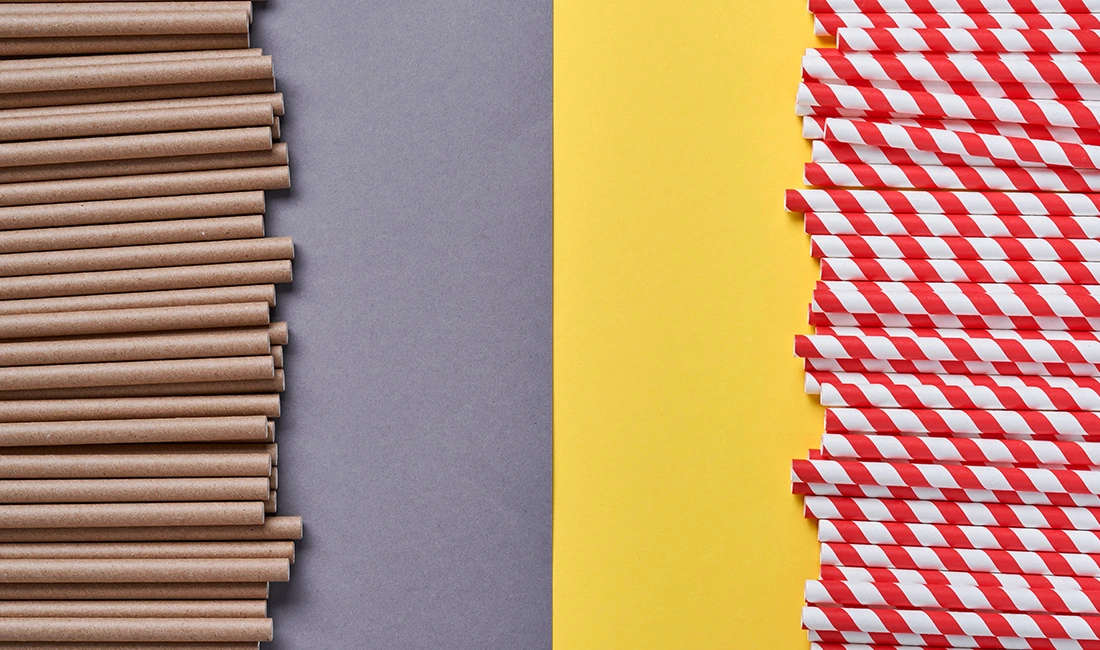
The plastic straw is out. But its two main replacements — paper and PLA — could not be more different. One collapses in a cocktail glass before the first toast is finished. The other looks and feels like the plastic everyone just agreed to stop using.
For party hosts navigating this choice, the decision comes down to more than just “which is greener.” Durability, taste, chemical safety, legal compliance, cost, and disposal all matter — and the right answer changes depending on the event. This guide examines the straw decision from every angle that matters, drawing on peer-reviewed research and practical tableware planning knowledge to help hosts make an informed choice.
A paper straw is a single-use drinking tube made from multiple layers of food-grade paper bonded with adhesive and coated for water resistance. A PLA straw is a bioplastic drinking tube extruded from polylactic acid, a polymer derived from fermented corn or sugarcane starch. Both carry eco-friendly labels, but the details behind those labels differ dramatically.
What Are Paper and PLA Straws Actually Made Of?
A paper straw is a multi-layered tube of food-grade kraft paper, bonded with adhesive and coated with wax or polyethylene (PE) for water resistance. A PLA straw is an extruded bioplastic tube made from polylactic acid resin, produced by fermenting corn or sugarcane starch into lactic acid and then polymerizing it into a moldable polymer.
These two manufacturing processes explain why the straws behave so differently in a drink. Paper straw production begins with flat sheets of kraft paper that pass through an adhesive bath, get wound tightly around a mandrel, then are cut and coated. The coating step is the single biggest quality variable — a high-grade wax or PE layer keeps liquid out for 45–60 minutes, while a cheap or thin coating lets water in almost immediately. Two straws that look identical out of the wrapper can perform completely differently in a glass of lemonade.
PLA straw production follows a different path entirely. Agricultural starch is fermented into lactic acid, polymerized into resin pellets, then melted and pushed through an extruder to form a hollow tube. The precision of this extrusion — wall thickness, diameter consistency, cooling speed — determines whether the finished straw holds firm or cracks under pressure.
How Does Coating Quality Affect Paper Straw Performance?
Coating quality is the single largest determinant of how long a paper straw lasts in liquid, yet it is invisible on packaging. A manufacturer using food-safe wax at the right thickness produces a straw that lasts three to four times longer than one from a manufacturer cutting corners on coating material. This gap makes sample testing before any bulk order more valuable than comparing price lists alone.
How Long Does Each Straw Last in a Drink at a Party?
Paper straws lose 70–90% of their compressive strength within 30 minutes in liquid and remain functional for about 30–60 minutes in cold drinks. PLA straws maintain full structural integrity for 3–4 hours, lasting through an entire party.
A 2019 study published in BioResources tested commercial paper straws in water, Coca-Cola, and sweet tea, finding that paper straws collapsed across all beverages within half an hour. Acidic drinks like citrus cocktails accelerate breakdown further, while drinks served over ice at around 4°C can extend paper straw life to several hours.
PLA straws showed minimal water absorption during the same testing window. Their dense polymer matrix blocks liquid penetration, making them functionally similar to traditional polypropylene straws for cold beverages.
At a typical party, drinks sit on tables or at self-serve stations for 30 to 90 minutes — a window where paper straws may need mid-event replacement while PLA straws will not. For kids’ tables, where drinks get forgotten and slowly nursed, PLA’s durability advantage is most pronounced.
Does PLA Hold Up in Hot Drinks or Outdoor Heat?
PLA begins softening at 55–60°C (131–140°F), making it unsuitable for hot coffee, tea, or any warm beverage. At a summer patio party with straws near a grill or in direct sunlight, PLA can warp. Paper handles heat better — though it still softens from moisture. The practical rule is straightforward: PLA for cold drinks, paper or reusable alternatives for hot.
Does Straw Diameter Matter for Different Party Drinks?
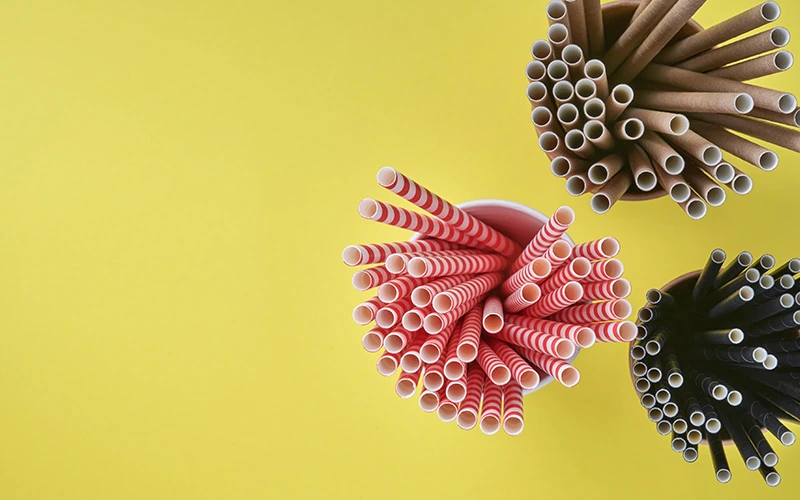
Straw diameter directly affects performance, and the wrong size renders even a high-quality straw unusable. Standard 6mm straws work for water, juice, soda, and cocktails with both materials. For smoothies and milkshakes (8–12mm), paper softens faster at wider diameters while PLA holds its shape. For bubble tea with tapioca pearls (14mm+), PLA is strongly preferred — paper at this width fails quickly. Hosts serving mixed drink menus benefit from ordering two diameters rather than one all-purpose size. At self-serve stations with sealed cup lids, PLA straws also puncture more reliably than paper.
Do Paper or PLA Straws Change the Taste of Drinks?
Paper straws absorb roughly 30% of their weight in water within 10 minutes, triggering ion leaching that gives drinks a papery flavor. PLA straws have a dense polymer matrix that blocks mass exchange, keeping beverages taste-neutral throughout use.
Research published in Carbon Research (Springer) confirmed that paper’s open fiber structure allows rapid liquid penetration, with conductivity measurements showing ion transfer into the drink. Consumers commonly describe this as a “cardboard” aftertaste that worsens with time. PLA showed virtually no mass exchange — in blind taste tests, most participants could not distinguish PLA from traditional plastic.
This difference creates a practical pairing strategy for event planning. Flavor-sensitive drinks — craft cocktails, wine spritzers, fresh juice, sparkling water — pair better with PLA. Strongly flavored or thick beverages like milkshakes and smoothies mask a faint paper note, making paper straws acceptable for those drinks.
Beyond taste, straws communicate something about an event. A soggy paper straw drooping in a craft cocktail signals “budget.” A smooth, clear PLA straw in a champagne flute signals attention to detail. This perception matters most at weddings, corporate receptions, and milestone birthdays where the complete table presentation — from plates and glasses to the smallest accessories — shapes the guest experience.
Which Straw Is More Eco-Friendly — Paper or PLA?
Paper straws biodegrade in 2–6 weeks and can be home composted. PLA straws require industrial composting facilities maintaining 55–60°C for weeks to break down. Without access to such facilities, PLA straws persist in landfills like conventional plastic.
The end-of-life gap between these two materials is where marketing and reality diverge most sharply. Paper straws made without heavy plastic coatings decompose in a standard backyard compost bin within weeks — a straightforward disposal path. PLA’s “compostable” label is technically accurate but practically misleading: the required industrial conditions are not available in most U.S. communities, and without those facilities a PLA straw sits underground for decades.
What Do “Biodegradable,” “Compostable,” and “Recyclable” Actually Mean?
“Biodegradable” is a general term meaning a material will eventually break down by natural organisms, but with no guaranteed timeframe — decomposition could take years in a landfill. “Compostable” is a regulated claim meaning the material degrades within a certified timeframe under specific conditions, either home or industrial. “Recyclable” means the material can be reprocessed into new product, but only if local programs accept it and sorting systems capture it — and straws, being small and lightweight, routinely slip through. For party hosts deciding between paper and PLA, the practical takeaway is direct: “compostable” on a label does not guarantee a backyard bin will work, and “recyclable” does not mean the local facility will take it.
What Is the Difference Between Home Compostable and Industrial Compostable?
Home compostable is a certification category for products that break down at ambient temperatures of 20–30°C over about 12 months in a standard backyard bin, verified by TÜV OK compost HOME certification. Industrial compostable is a separate category requiring commercial facilities running at 55–60°C, with disintegration in about 3 months and full biodegradation within 6, verified by BPI (ASTM D6400/D6868) or TÜV OK compost INDUSTRIAL. The deciding question for any event is whether the local waste hauler accepts industrially compostable items — if not, PLA straws from the party end up in landfill.
What Is the Carbon Footprint of Making Paper vs PLA Straws?
Paper straw production generates an estimated 2–3 kg CO₂ per 1,000 straws due to water- and energy-intensive pulping, bleaching, and drying, though figures vary by manufacturer and production method. PLA production uses renewable agricultural feedstock with generally lower greenhouse gas emissions than petroleum-based plastic, but the corn or sugarcane crops behind it require land, water, and fertilizer. Neither material is zero-impact; the most sustainable choice depends on local disposal infrastructure.
Do Paper Straws Contain PFAS “Forever Chemicals”?
Yes — a 2023 University of Antwerp study found PFAS in 90% of paper straws tested. A separate 2021 University of Florida study detected 21 PFAS compounds in 36 of 38 plant-based straws, while the five plastic straws in its sample showed no measurable PFAS. Concentrations were low but accumulate in the body over time.
PFAS (per- and polyfluoroalkyl substances) are a class of synthetic chemicals used in water-repellent coatings — the same coatings that give paper straws their liquid resistance. The Belgian study, published in Food Additives & Contaminants, tested 39 brands across five materials: paper straws showed a 90% detection rate, bamboo 80%, plastic 75%, glass 40%, stainless steel 0%. The U.S. study, published in Chemosphere, tested a smaller sample and found roughly two-thirds of extractable PFAS leached into water at typical beverage temperatures. The Antwerp study, with a larger plastic straw sample, detected PFAS in 75% of plastic straws as well — meaning no single material is guaranteed clean except stainless steel.
PLA’s extrusion process does not require waterproofing coatings, giving it a generally lower PFAS risk profile, though PLA was not the primary focus of either study.
How Can You Verify a Straw Is PFAS-Free Before Buying?
Verification requires a third-party total organic fluorine testing report from the supplier. The BPI certification threshold for compostable products sets total organic fluorine at below 100 ppm. Coating details matter as well — food-safe wax or PE coatings are preferable to unspecified chemical treatments. A supplier that cannot provide this documentation on request is a red flag worth heeding.
Are PLA Straws Legal in Europe and the United States?
PLA straws are banned across the EU and in England and Scotland. The EU Single-Use Plastics Directive (2019/904) classifies PLA as plastic, prohibiting its sale since July 2021. England banned plastic straws including PLA from October 2020, with Scotland following in 2022. In the US, PLA straws remain generally legal, though some states and cities restrict all single-use straws.
The EU directive explicitly includes bioplastics — PLA undergoes fermentation and polymerization, disqualifying it from the “natural polymers not chemically modified” exemption. Paper straws remain fully compliant in both the EU and UK markets. In the U.S., California, Vermont, Delaware, and dozens of cities have enacted restrictions, with some requiring straws to be offered on request only. Ordering PLA for a European event means illegal inventory on arrival — paper is the universally compliant choice.
How Much Do Paper and PLA Straws Cost for a Party?
Paper straws cost approximately 0.02–0.02–0.02–0.05 per unit in bulk, while PLA straws run 0.04–0.04–0.04–0.08 per unit. For a 100-guest party with 2–3 straws per person, that translates to roughly 6–6–6–15 for paper or 12–12–12–24 for PLA. Prices vary by supplier, order volume, and customization level.
The price gap reflects production complexity. Paper straw manufacturing uses widely available raw materials and simpler machinery. PLA requires specialized resin, precision extrusion equipment, and tighter quality control, all of which push the per-unit price higher. PLA’s premium feel — smooth, clear, plastic-like — can elevate the perceived quality of an event, which may justify the extra spend for weddings or corporate receptions.
How Many Straws Should You Order Per Guest?
The standard planning formula is 2–3 straws per person over a 3–4 hour event. Paper straws need a 20% buffer for humidity-related losses. PLA needs less buffer due to its durability advantage. Placing straws at a self-serve station instead of pre-setting them at every seat can reduce total consumption by an estimated 20–30%, directly lowering both cost and waste.
Can You Customize Straws with Party Themes and Logos?
Paper straws are the easier material to customize — the flat paper surface takes ink well, minimum order quantities are low, and turnaround is typically 2–3 weeks. PLA straws can also be branded and produced in custom colors, but larger minimum quantities and longer lead times (4–6 weeks) make them better suited for weddings and corporate events where a premium, polished look justifies the planning horizon.
How Should You Store and Dispose of Party Straws After the Event?
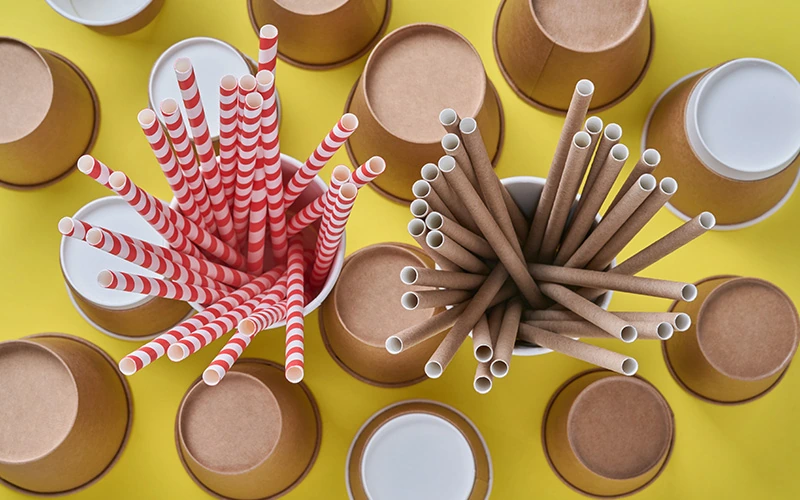
Paper straws require sealed, cool, dry storage — humidity degrades them before use. PLA straws tolerate moisture but must be kept away from heat above 55°C. After the event, paper goes into compost or general waste; PLA requires industrial composting only and must never enter recycling bins.
How Long Can You Store Straws Before They Go Bad?
Unopened paper straws have a shelf life of 2–3 years in dry storage; once opened, they should be used within weeks in humid climates. PLA straws typically carry a manufacturer-recommended shelf life of 12–24 months, depending on formulation and storage conditions — beyond that, the material may become brittle or slightly discolored. For outdoor event setups, paper straws placed on tables hours before guests arrive risk absorbing ambient moisture and failing prematurely.
What Is the Correct Way to Dispose of Each Straw Type?
Paper straws go into compost (home or municipal) or general waste — a straightforward disposal path. PLA straws must go to industrial composting only, never into recycling bins. PLA is the single biggest source of recycling contamination at events: it looks identical to conventional PP plastic, so guests instinctively toss it into recycling, where even one PLA straw can compromise an entire batch. Clear bin labeling with specific disposal instructions is essential at any event using PLA. When a venue or city does not offer industrial composting pickup, PLA straws will functionally end up in landfill, making paper the more responsible default in those situations.
Paper or PLA — Which Straw Should You Choose for Your Party?
Paper straws are the better fit for casual, budget-friendly events with quick-sip drinks and universal legal compliance. PLA straws are the better fit for upscale US events with flavor-sensitive cocktails where drinks sit for extended periods. The smartest hosts mix both — matching the straw to each drink station.
Paper works best for kids’ birthdays, backyard BBQs, and picnics where drinks are consumed quickly; for thick or strongly flavored beverages; when themed customization matters; and when guaranteed legal compliance across all jurisdictions — including the EU and UK — is required.
PLA works best for weddings, corporate cocktail hours, and bridal showers in the United States; for flavor-sensitive drinks at self-serve stations; and when industrial composting facilities are available locally.
The smartest approach is mixing both — PLA at the cocktail bar where drinks linger and flavor matters, paper at the kids’ station where fun designs beat durability concerns.
|
Feature |
Paper |
PLA |
|
Durability (cold) |
30–60 min |
3–4 hours |
|
Taste impact |
Papery flavor possible |
Taste-neutral |
|
Home compostable |
Yes |
No |
|
EU/UK legal |
Compliant |
Banned |
|
Cost/unit |
0.02–0.02–0.02–0.05 |
0.04–0.04–0.04–0.08 |
A pre-purchase checklist includes FDA food-contact compliance, PFAS-free certification for paper, BPI or ASTM D6400 verification for PLA, and third-party test reports from the supplier.
For hosts exploring beyond paper and PLA, emerging alternatives are worth watching. PHA (polyhydroxyalkanoate) is a bioplastic produced by bacterial fermentation that can biodegrade in home compost, soil, and even marine environments — unlike PLA. PHA straws remain more expensive and less widely available, but the technology is maturing rapidly. Bamboo, sugarcane fiber, and stainless steel straws each carry different trade-offs in cost, durability, and disposal.
Once the straw choice is settled, the rest of the table deserves the same attention. Coordinating plates, cups, champagne flutes, and napkins with the event theme creates a cohesive table setting that guests notice — and that kind of thoughtful detail is what turns a good party into a memorable one.