

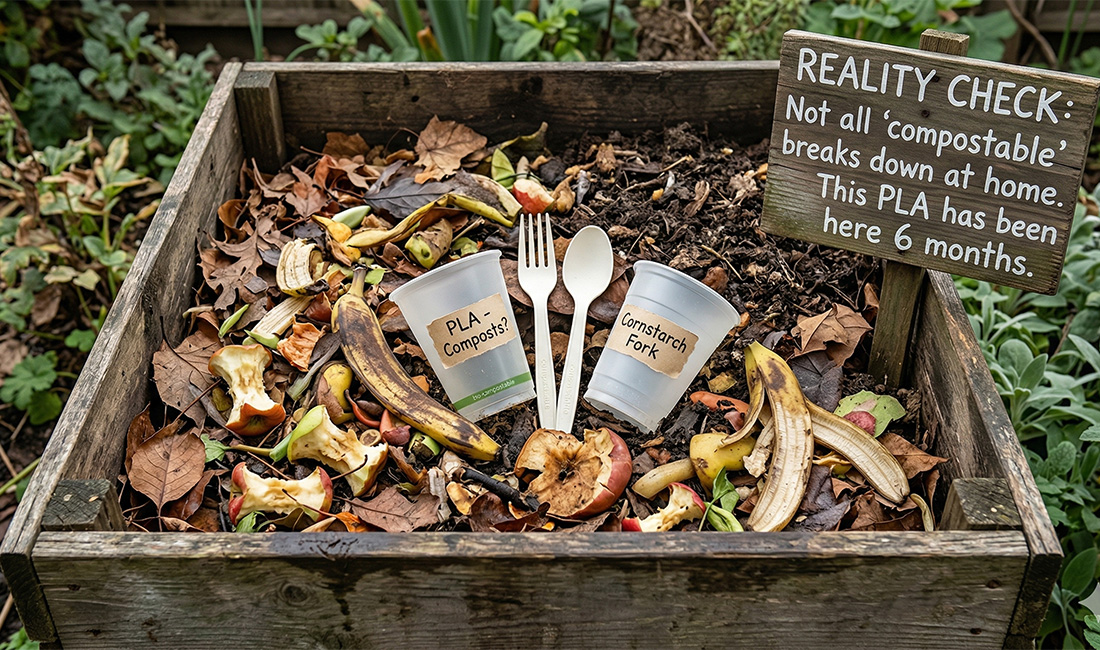
The word “compostable” appears on an increasing number of disposable plates, cups, and cutlery packages — and for environmentally conscious event planners, it sounds like the ideal solution. But the reality behind that label is more complicated than the packaging suggests. Many products marketed as compostable require industrial-grade facilities operating at sustained high temperatures to break down, and most North American households — and even many municipalities — lack access to such infrastructure. When compostable dinnerware cannot reach the right facility, it often ends up in a landfill, where it behaves much like conventional plastic. This guide separates marketing claims from material science, examining which plant-based tableware materials actually decompose at home, which demand industrial processing, and how event planners can make purchasing decisions based on disposal realities rather than label promises.
What Is Compostable Tableware?
Compostable tableware is single-use dinnerware made from plant-based or natural fiber materials — such as sugarcane bagasse, PLA (polylactic acid), or molded pulp — that is designed to break down into organic matter under specific composting conditions within a defined timeframe. The term “compostable” is not synonymous with “biodegradable,” which carries no time requirement and no guarantee of leaving non-toxic residue.
The critical distinction that most product labels fail to communicate clearly is that “compostable” is a conditional claim. A plate or cup does not simply dissolve after disposal — it requires a particular combination of temperature, moisture, oxygen, and microbial activity to decompose within the timeframe promised by its certification. Without those conditions, the product may persist in the environment for years or even decades, regardless of what the packaging states.
Why Does the Same “Compostable” Label Mean Different Things for Home and Industrial Composting?
The same “compostable” label carries different practical meanings because home composting and industrial composting operate at fundamentally different temperatures, and temperature is the single most important variable determining whether a given material will decompose.
How Does Home Composting Work and What Conditions Does It Provide?
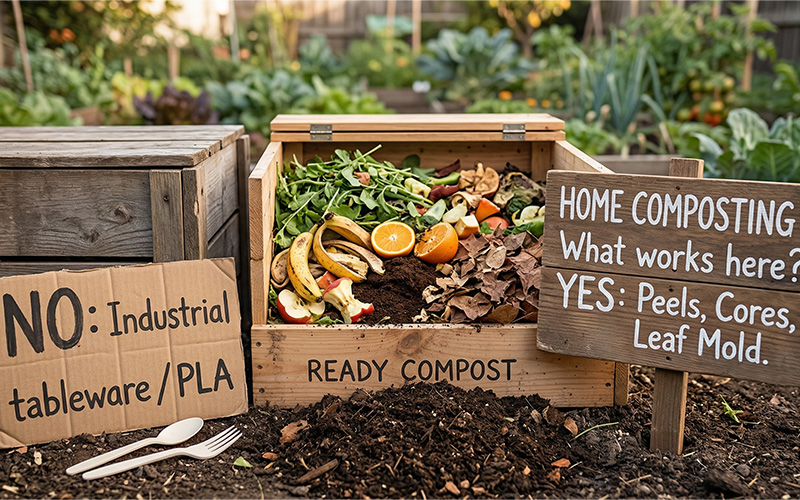
Home composting relies on natural microbial activity in small-scale bins, tumblers, or open piles, typically maintained in residential backyards. Temperatures fluctuate with the seasons and rarely sustain levels above 60°C, even in well-managed systems. Most home compost piles operate in the 20–55°C range, depending on volume, aeration, and the balance of carbon-rich and nitrogen-rich inputs. This temperature range is sufficient for breaking down food scraps, yard waste, and thin uncoated paper products — but it falls short of the threshold required to decompose engineered bio-based materials like PLA. Decomposition cycles in home composting typically span several months to over a year.
How Does Industrial Composting Differ in Temperature and Processing Capacity?
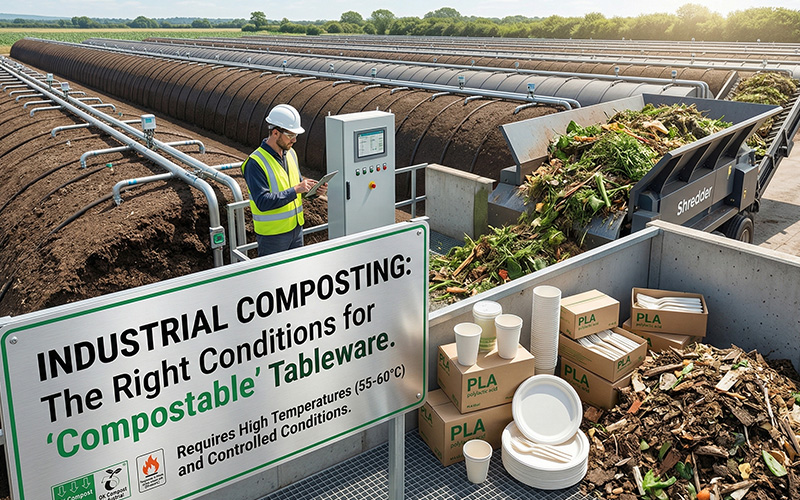
Industrial composting facilities — also called commercial composting operations — use mechanical turning, forced aeration, and controlled moisture management to maintain sustained temperatures between 55°C and 70°C across large-volume windrows or in-vessel systems. These conditions accelerate microbial activity far beyond what a backyard pile can achieve, enabling the breakdown of dense, engineered materials that home systems cannot process. The major North American certification for compostable products, BPI (Biodegradable Products Institute), tests materials against the ASTM D6400 standard — and those test conditions simulate industrial facilities, not home compost bins. This distinction is rarely made clear on consumer-facing labels.
Which Plant-Based Dinnerware Materials Actually Break Down in a Backyard Compost Pile?
The range of disposable tableware materials that reliably decompose in home composting conditions is narrow, limited primarily to thin, uncoated paper products and certain lightweight natural fiber items.
Why Do Uncoated Paper Plates and Napkins Compost Well at Home?
Uncoated paper plates and napkins break down effectively in home compost because their loose cellulose fiber structure is easily accessible to microorganisms even at moderate temperatures. Food-soiled paper napkins are actually better suited for composting than recycling, since grease and food residue disqualify paper from most recycling streams. The essential requirement is that the paper must be free of plastic or polyethylene coatings — shiny, moisture-resistant surfaces indicate a synthetic lining that will not decompose. A simple test involves tearing the product: uncoated paper tears into rough fibrous edges, while coated paper resists tearing or reveals a thin film layer.
Why Do Most Molded Fiber and Bagasse Products Need Higher Temperatures?
Molded fiber plates and sugarcane bagasse containers are denser and thicker-walled than standard paper products, which means they require more sustained heat and microbial activity to break down fully. Some bagasse items may eventually decompose in a home pile, but the process can take well over six months — far longer than typical food scraps — and decomposition is often uneven, leaving partially intact fragments. Research from the University of Sheffield found that bagasse-based tableware achieved roughly 60% decomposition after 12 months under controlled aerobic home composting conditions, while PLA items in the same trial showed less than 5% weight loss — a stark illustration of the material performance gap.
Why Do PLA and Other Bio-Based Disposables Require Industrial Facilities to Decompose?
PLA-based tableware and most products carrying BPI or ASTM D6400 certification require the sustained high temperatures of industrial composting because their molecular structure resists hydrolysis below approximately 58°C.
Why Does PLA Tableware Fail to Decompose in Home Compost?
PLA fails in home compost because its polymer chains do not begin the hydrolysis process — the chemical reaction that breaks the material into lactic acid monomers — until temperatures consistently exceed 58°C. A typical backyard compost pile rarely reaches this threshold for more than brief periods, and certainly cannot sustain it for the weeks required to initiate meaningful PLA degradation. The Sheffield University study confirmed this limitation: standard PLA cutlery retained over 95% of its original weight after a full year in home composting conditions. In practical terms, a PLA plate placed in a backyard bin will look virtually unchanged months later.
What Happens When “Compostable” Tableware Ends Up in a Landfill?
When compostable tableware reaches a landfill instead of a composting facility, it enters an anaerobic environment with minimal oxygen, moisture, and microbial diversity — conditions that are the opposite of what these materials need to decompose. Under landfill conditions, PLA may persist for 100 to 1,000 years, a degradation timeline functionally identical to conventional petroleum-based plastic. Even certified compostable products are not designed to break down in landfills. This reality represents the most significant gap between consumer expectation and material performance in the compostable tableware market.
What Are the Advantages and Disadvantages of Choosing Eco-Labeled Disposable Dinnerware?
Eco-labeled disposable dinnerware offers genuine environmental benefits under specific conditions but also carries real-world limitations that hosts should weigh carefully.
What Are the Main Benefits When Proper Infrastructure Exists?
The primary advantage of compostable dinnerware is landfill diversion — when products successfully reach an industrial composting facility, they convert into nutrient-rich soil amendment rather than occupying landfill space. Plant-based materials also reduce dependence on petroleum feedstocks during production. For events where environmental messaging is central to the occasion — corporate sustainability showcases, eco-themed weddings, community green initiatives — compostable tableware reinforces that narrative visually and practically.
What Real-World Limitations Should Hosts Consider?
The core limitation is infrastructure dependency. Many North American communities lack industrial composting services that accept tableware, and even among facilities that exist, some refuse compostable dinnerware due to concerns about PLA contaminating their organic certification compliance. Performance is another consideration — plant-based plates and cups generally offer less structural rigidity than premium plastic alternatives, with a tendency to soften or leak under hot, heavy, or saucy foods. Per-unit costs for certified compostable products typically exceed those of comparable plastic items. If compostable dinnerware ultimately enters a landfill due to infrastructure gaps, its environmental advantage over conventional disposables diminishes dramatically.
How Do Certified Compostable Products Compare to Premium Plastic Dinnerware for Events?
Certified compostable products and premium plastic dinnerware differ fundamentally in structural performance, disposal pathways, and the conditions under which each choice delivers the most practical value.
When Is Compostable Dinnerware the Better Choice for an Event?
Compostable dinnerware is the stronger choice when the event venue has a confirmed partnership with an industrial composting service that explicitly accepts tableware products. Smaller, informal gatherings serving cold or light foods — salads, fruit, sandwiches — place less structural demand on plates and cups, making compostable materials adequate for the task. Events with an environmental mission, such as sustainability conferences or zero-waste community celebrations, also benefit from the alignment between compostable products and the occasion’s messaging.
When Is Premium Plastic Dinnerware the More Practical Option?
Premium plastic dinnerware is the more practical option when events involve hot foods, heavy portions, or saucy dishes that demand structural rigidity without bending or leaking. Formal occasions — weddings, corporate galas, milestone celebrations — require a polished visual presentation that premium plastic plates and elegant cups deliver more consistently than plant-based alternatives. When local composting infrastructure is unavailable or does not accept tableware, choosing premium plastic avoids the false economy of paying a compostable premium for products that will ultimately reach a landfill anyway. Plastic tableware also pairs more reliably with formal drinkware like wine glasses and champagne flutes to create a cohesive table setting.
How Can Event Planners Verify Compostable Claims Before Purchasing?
Verifying compostable claims should begin with checking for recognized third-party certification logos rather than relying on front-of-package marketing language like “eco-friendly,” “plant-based,” or “earth-friendly.”
The BPI (Biodegradable Products Institute) certification mark is the most widely recognized standard in North America, indicating that a product has passed ASTM D6400 testing for compostability under industrial conditions. Crucially, this certification does not imply home compostability — the fine print typically specifies “in commercial composting facilities.” Event planners should confirm two things before purchasing: first, that the product carries a legitimate third-party certification with a verifiable certification number; and second, that a local composting facility actively accepts compostable tableware. Many industrial composters only process food scraps and yard waste, rejecting tableware entirely. One additional caution: compostable tableware must never be placed in a recycling bin. PLA closely resembles PET plastic in appearance, and when the two are mixed, PLA contaminates the PET recycling batch, potentially causing the entire load to be rejected.
What Happens to Compostable Dinnerware That Cannot Reach an Industrial Facility?
Compostable dinnerware that cannot reach an industrial composting facility almost always ends up in a landfill, where it does not decompose as designed and delivers minimal environmental benefit compared to conventional disposable alternatives.
This is the central paradox of the compostable tableware market: the product is engineered to perform in a specific facility type, but the infrastructure to process it remains limited across much of North America. Without access to sustained high temperatures and controlled composting conditions, PLA plates sit in landfills alongside petroleum-based plastic, persisting for decades or centuries. For event planners navigating this reality, the most honest approach is to match tableware material choices to the disposal options that are actually available — not the ones that might exist in an ideal scenario. When composting infrastructure is confirmed and accessible, compostable products serve their intended purpose. When it is not, premium plastic tableware paired with clear napkin-inclusive sorting stations and local recycling guidelines represents a more transparent and effective disposal pathway.
FAQs
Does “biodegradable” mean the same thing as “compostable” on tableware packaging?
These terms are not interchangeable. “Biodegradable” indicates only that a material will eventually break down through natural processes, with no specified timeframe — decomposition could take decades. “Compostable” carries a defined standard (typically 90–180 days under ASTM D6400 conditions) and requires that the end product leave no toxic residue. However, that standard assumes industrial composting conditions, not a backyard bin.
Can compostable plates and cups be placed in a regular recycling bin?
Compostable tableware should never enter a recycling bin. PLA, the most common bio-based plastic used in compostable dinnerware, is nearly indistinguishable from PET plastic in appearance. When PLA enters a PET recycling stream, it contaminates the batch, potentially causing the entire load to be rejected and rerouted to a landfill — the opposite of the intended outcome.
Is premium plastic tableware wasteful compared to compostable alternatives?
The comparison depends entirely on local disposal infrastructure. If an industrial composting facility that accepts tableware is available, compostable products achieve genuine landfill diversion. If no such facility exists — which is the case in many North American communities — compostable dinnerware ends up in the same landfill as conventional products, with a similar decomposition timeline. In that scenario, premium plastic tableware that offers superior performance during use and follows a transparent disposal pathway through local waste guidelines represents an equally responsible and often more practical choice.