

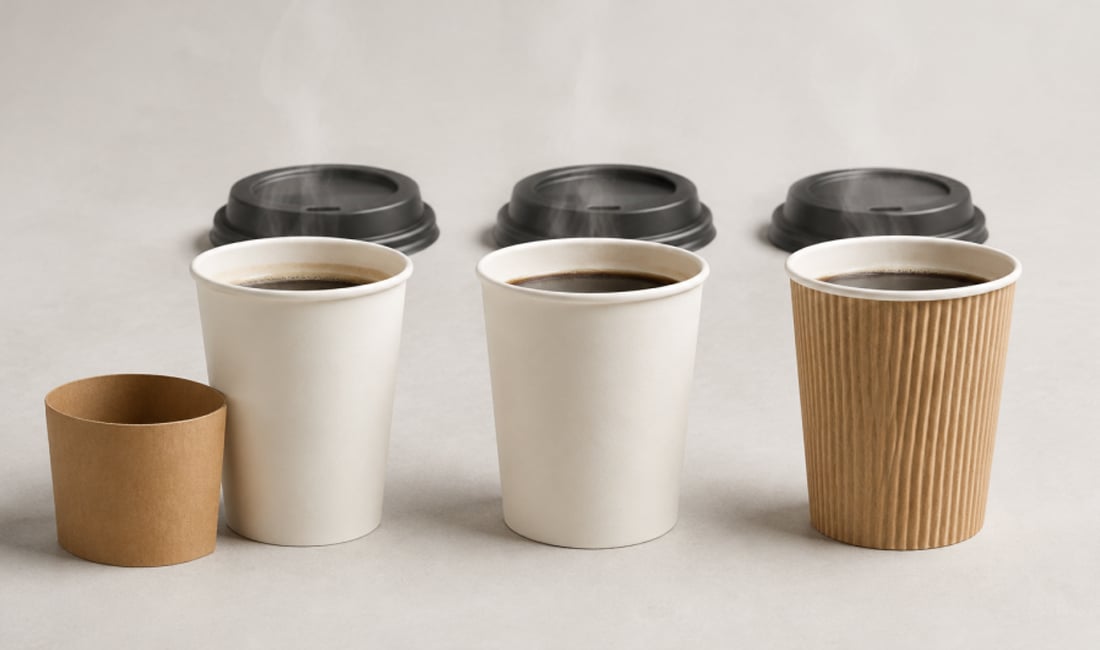
A hot drink can expose a weak cup very quickly. Thin walls may become too hot to hold. Poor seams can soften or leak. A loose lid can turn a short walk into a messy one.
The best disposable cup is therefore not defined by material alone. It must suit the drink, serving temperature, holding time, and setting. Coffee carried to work may need more insulation than tea served at a meeting. Hot cocoa may need extra space for foam, marshmallows, or whipped toppings.
For most hot drink service, a hot-rated paper cup remains the most flexible option. Single-wall cups can work for short service when paired with sleeves. Double-wall and ripple-wall cups provide more built-in insulation. Certain polypropylene cups can also hold hot drinks, but only when the product is clearly rated for that use.
What Makes a Disposable Cup Suitable for Hot Drinks?
A cup that holds cold soda safely is not automatically suitable for coffee or tea. Hot drinks place more stress on the cup, coating, seams, and lid.
Heat Resistance and Food-Contact Safety
The first requirement is simple: the complete cup must be approved for contact with hot food or drinks at the intended temperature.
This applies to more than the base material. Coatings, adhesives, printing inks, and lid components are all part of the finished package. The FDA treats packaging and its components as food-contact substances, so buyers should check the intended use rather than rely on terms such as “paper,” “plastic,” or “food grade” alone.
A reliable supplier should be able to identify:
• The main cup material
• The inner barrier or coating
• The intended temperature range
• The matching lid specification
• Relevant food-contact documents
A cup should not bend, split, soften, or release a strong odor when filled under its normal service conditions.
Insulation and Comfortable Handling
Heat resistance and insulation are related, but they are not the same.
A cup may keep its shape around a hot drink while still becoming uncomfortable to hold. Single-wall paper cups often need a cardboard sleeve. Double-wall and ripple-wall cups place another layer between the drink and the hand, which can improve comfort and reduce the need for separate sleeves.
Service time also matters. A drink consumed beside a buffet table has different needs from one carried on a long commute. The longer the expected holding time, the more useful built-in insulation becomes.
A cup cannot make an unsafe serving temperature safe. Beverage temperature still needs to be managed carefully, especially at events where children or older guests may be present.
Leak Resistance and Structural Strength
Hot liquid can place stress on the bottom seam and soften paper over time. A good hot cup therefore needs a stable base, an even rim, and a barrier layer that limits liquid absorption.
Strength becomes more important with larger drinks. A full 16 oz cup places more weight on the sidewall and bottom than a small espresso cup. The cup should remain firm when lifted, carried, and placed in a holder.
The true test is not how an empty cup feels. It is how the cup performs after holding the actual drink for the expected serving period.
Secure Lid Fit and Drinking Comfort
A lid should fit the exact cup, not simply a cup with the same printed capacity.
Two 12 oz cups may have different rim diameters, wall thicknesses, or rolled-edge shapes. Their lids may not be interchangeable. Mixing products from different lines without testing can lead to leaks or lids that pop loose.
For standard coffee and tea, a heat-rated sip-through lid usually offers the most practical setup. Hot cocoa with toppings may need more clearance. However, many clear dome lids are made for cold drinks. A raised lid should only be used when both the lid and cup are approved for the beverage temperature.
Disposable Hot Cup Materials Compared
Material affects heat resistance, insulation, appearance, storage, and disposal. Each option has a place, but each also has limits.
Paper Cups: The Most Versatile Choice for Hot Drinks
Paper cups are widely used for coffee, tea, and cocoa because they are light, stackable, and easy to print. They are also available in single-wall, double-wall, and ripple-wall formats.
Most paper hot cups need an inner barrier to stop liquid from soaking into the paperboard. Depending on the product, this may be a plastic-based, plant-based, or water-based coating.
That coating affects disposal. A cup that looks like plain paper is not automatically recyclable or compostable. Local facilities may handle different coatings in different ways. Environmental claims should therefore be checked against the actual cup construction and local waste system.
Foam Cups: Strong Insulation with Disposal Limits
Foam cups often provide good insulation at a low weight. They can keep the outside surface comfortable without a separate sleeve, which makes them convenient for basic coffee stations and large events.
The trade-off comes after use. Foam foodservice packaging is not accepted by many recycling programs, and local rules may limit where it can be sold or used. Buyers should confirm local requirements before choosing it for a large order.
Foam can still perform well as a cup material, but insulation alone does not make it the best choice for every location.
Heat-Rated PP Cups: Use Only When Approved for Hot Drinks
Some polypropylene, or PP, cups are designed for both hot and cold beverages. They can offer good moisture resistance and a lighter appearance than paper.
However, not every PP cup has the same temperature rating. Thin party cups and cold beverage cups should not be treated as hot cups simply because they are made from PP. The finished product specification remains more important than the resin name.
PP also provides less built-in insulation than a double-wall paper cup in many designs. A sleeve may still be needed if the outer surface becomes uncomfortable.
Cold-Cup Materials That Should Not Hold Hot Beverages
Clear PET cups are normally intended for cold drinks. They should not be used for fresh coffee, hot tea, or cocoa unless a specific product states otherwise.
The same caution applies to many clear PLA cups, which are commonly made for cold service. This is different from a paper hot cup that uses PLA as a thin inner lining. A PLA-lined paper cup may be suitable for hot drinks when the complete cup is designed and tested for that use.
Material names can be misleading when taken out of context. The intended-use label should always decide where a cup belongs.
Single-Wall vs. Double-Wall vs. Ripple-Wall Paper Cups
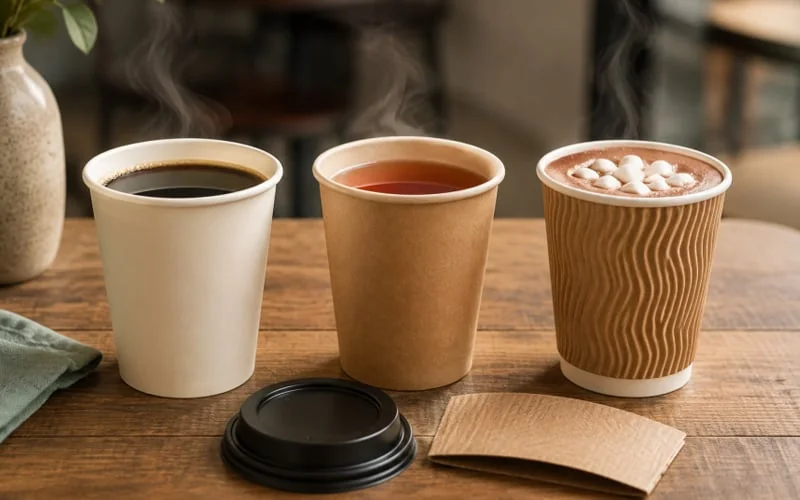
Once paper has been selected, the next decision is the wall structure.
|
Cup structure |
Built-in insulation |
Sleeve requirement |
Best suited to |
|---|---|---|---|
|
Single-wall |
Low |
Often needed for hot drinks |
Short service, budget-focused events, quick refills |
|
Double-wall |
Moderate to high |
Often not needed, but testing is still advised |
Takeaway coffee, offices, meetings, longer holding times |
|
Ripple-wall |
Moderate to high with added grip |
Often not needed |
Busy beverage stations, outdoor service, premium presentation |
Single-Wall Cups: Best for Short Service with Sleeves
A single-wall cup uses one main layer of paperboard. It is light, compact, and usually less expensive per cup.
This format works well when drinks are served and consumed quickly. It can also suit large events where storage space and case cost matter. For freshly poured coffee or tea, a sleeve is often needed to make the cup comfortable to hold.
The full cost should include both the cup and sleeve. Double-cupping should not be treated as a planned insulation method because it increases waste and makes stock use less predictable.
Double-Wall Cups: Best All-Around for Takeaway Drinks
A double-wall cup adds a second paper layer around the inner cup. The space between the layers slows heat transfer to the hand.
This makes double-wall cups a practical all-around option for takeaway coffee, office meetings, and catered events. They can also simplify service because staff do not need to add a sleeve to every drink.
The cup costs more than a basic single-wall design, but the final difference may become smaller once sleeve cost, storage, and service time are included.
Ripple-Wall Cups: Best for Grip and Built-In Insulation
A ripple-wall cup uses a textured outer layer. The raised surface creates small air spaces and gives the hand more grip.
This can be useful at outdoor events, winter markets, and busy self-service stations. Guests can hold the cup more securely, even while walking or carrying food.
Ripple cups also create a more visible, tactile presentation. However, they take up more storage space than thin single-wall cups and may cost more per unit. Their value depends on whether the extra grip and presentation support the event or brand experience.
No wall style guarantees good performance by itself. Paper quality, seam control, coating, cup size, and lid fit still matter.
Best Disposable Cups for Coffee, Tea & Cocoa
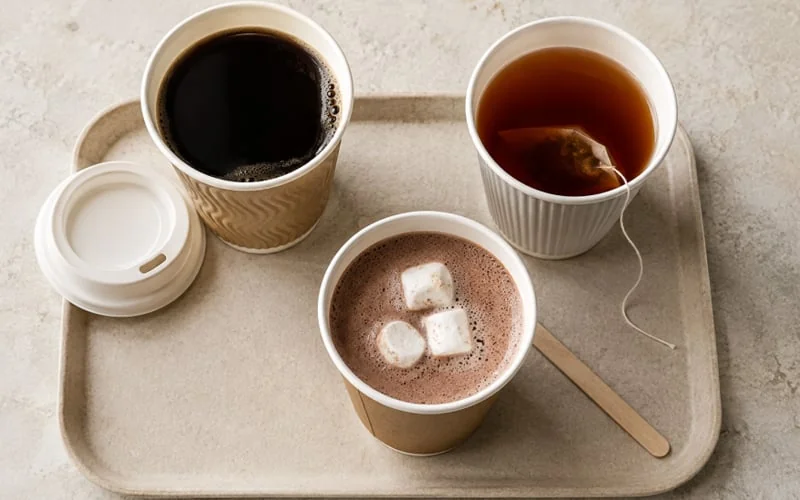
Coffee, tea, and cocoa are often grouped together as hot drinks, but they do not always need the same setup.
Coffee: Match Insulation to Serving Time
Coffee service ranges from small espresso portions to large milk-based drinks. The right cup should reflect both the recipe and the time between pouring and drinking.
A single-wall cup with a sleeve may be enough for a breakfast buffet or meeting room. For takeaway orders, outdoor service, or longer commutes, double-wall and ripple-wall cups usually offer a more comfortable grip.
A secure sip lid is especially important when coffee will be carried. The lid should be tested with the filled cup rather than assumed to fit because the stated ounce sizes match.
Tea: Match the Cup to Brewing and Serving Temperature
Some tea is prepared with water close to boiling, while other styles use lower temperatures. The cup should be selected for the hottest tea that the service is likely to offer.
Insulated paper cups are useful when tea will steep or remain in the cup for several minutes. If a tea bag stays inside, its string should not prevent the lid from sealing fully.
A smaller menu can often use the same cup and lid family for coffee and tea. This reduces stock complexity, provided both drinks remain within the cup’s intended temperature range.
Cocoa: Leave Headspace for Foam and Toppings
Hot cocoa needs more planning around fill level. Milk foam, marshmallows, whipped cream, and stirring all require space above the drink.
An insulated 8 oz or 12 oz cup often works well for party and event service. Larger cups may suit specialty drinks, but they become heavier when full and need strong walls and a secure lid.
Plain cocoa can use a standard hot-drink lid. Drinks with tall toppings need a suitable raised lid or may be served without a lid at a controlled beverage station. Any dome-style lid must be rated for hot use.
The goal is not to use the largest cup. It is to leave enough room for the finished drink without creating a half-empty appearance.
Cup Sizes, Lids and Sleeves for Hot Drink Service
Common U.S. hot cup sizes range from small 4 oz espresso cups to 16 oz or 20 oz large-drink formats. The printed capacity is only a starting point.
The finished recipe also includes milk, foam, toppings, stirring space, and lid clearance. A cup filled to its maximum stated volume may not be practical to carry.
A simple size plan may include:
• 4–8 oz for espresso, tastings, and smaller drinks
• 10–12 oz for standard coffee, tea, and cocoa
• 16 oz for large takeaway drinks
• 20 oz only where the menu and customer demand support it
Facilities that need a more detailed breakdown can refer to the paper cup size guide for different beverages.
The cup and lid should be ordered as a tested pair. Rim diameter and product series matter more than the ounce number alone. Reducing the number of lid sizes can simplify storage, but only when the supplier confirms compatibility.
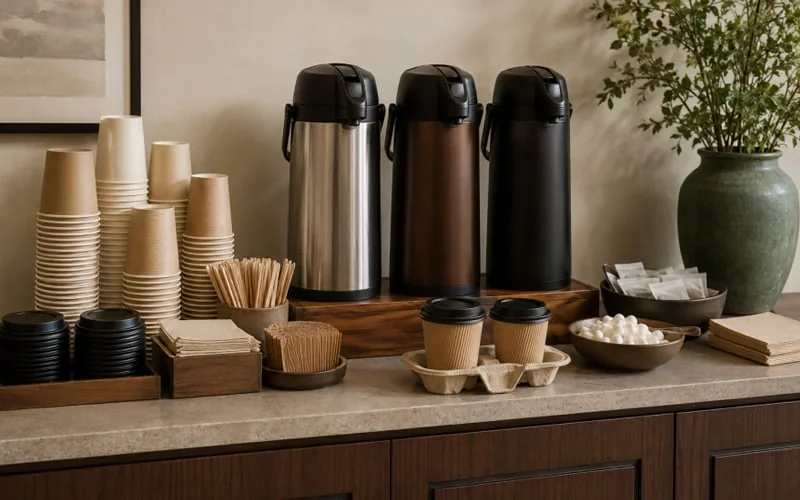
Sleeves should be added where the cup surface becomes uncomfortable. Carriers are useful for multi-cup orders, while stirrers and clear drink labels help keep coffee, tea, and cocoa service organized.
How to Choose Disposable Hot Cups for Cafés, Offices and Events
A good buying decision begins with the real service conditions, not with the lowest case price.
Start with Beverage Temperature and Holding Time
The buyer should first identify the hottest drink, the average portion, and how long guests are likely to hold it.
Short indoor service may work with single-wall cups and sleeves. Longer takeaway service usually benefits from double-wall or ripple-wall construction. The cup should also remain firm for the full expected drinking period.
Match Cup Construction to the Serving Setting
A café may prioritize lid security and speed. An office may prefer one or two sizes with shared lid systems. An event planner may focus on stackability, safe handling, and quick cleanup.
Outdoor service adds wind, uneven surfaces, and longer walking distances. In these settings, a textured cup, secure lid, and drink carrier may provide more value than the lowest unit price.
Test the Exact Cup-and-Lid Pair Before Buying in Bulk
Samples should be tested with the actual coffee, tea, or cocoa being served.
The test should check:
• Cup firmness after the normal holding period
• Outer-wall comfort
• Bottom and side seams
• Lid application and removal
• Drinking opening and venting
• Stability on trays and in carriers
• Space for milk foam or toppings
Testing should be controlled and safe. A filled hot cup should never be turned upside down to prove that the lid fits.
Once the combination passes, the exact cup, lid, and sleeve item numbers should be recorded. This prevents staff from replacing one part with a similar-looking but incompatible product.
Compare Total Cost per Serve, Not Cup Price Alone
The lowest cup price may not produce the lowest service cost.
A complete comparison includes:
• Cup
• Lid
• Sleeve
• Carrier
• Storage space
• Staff handling time
• Waste from leaks or incorrect lid matches
A double-wall cup may reduce sleeve use and simplify stock. A single-wall cup may still be more economical when only some drinks need a sleeve. The best result depends on the menu and service pattern.
Check Local Recycling, Composting and Foam Rules
Words such as “recyclable” and “compostable” do not guarantee that a cup can enter the local waste stream.
The U.S. EPA recommends choosing certified commercially compostable foodservice ware only when a local composting program accepts that product type. Recyclable products also need local acceptance. These conditions are explained in the EPA’s guidance on sustainable foodservice ware.
A brown paper finish does not prove that a cup is compostable. A plant-based coating does not mean it will break down in a home compost bin. Buyers should check certification, local collection, and the final disposal route before making environmental claims.
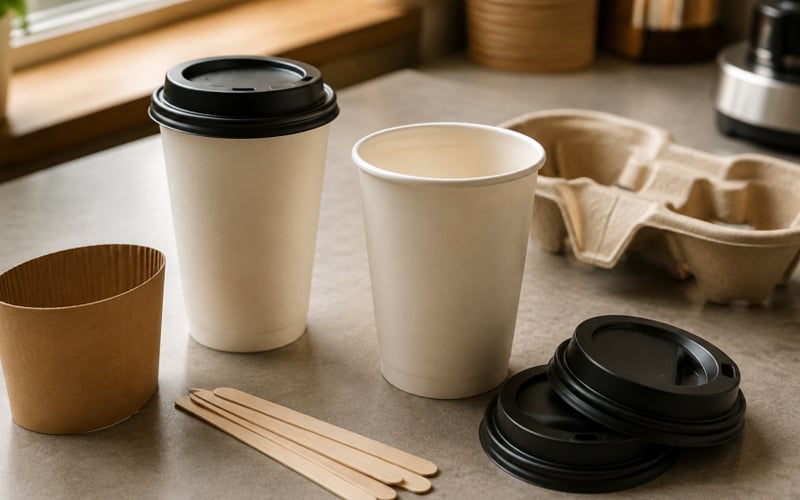
FAQs About Disposable Cups for Hot Drinks
Can Disposable Hot Cups Go in the Microwave?
Only when the product is clearly labeled microwave-safe.
A paper cup may contain a lining, adhesive, ink, or lid that is not designed for microwave heating. The FDA also notes that some plastic containers can soften or melt from the heat of the food or drink inside a microwave.
When reheating is needed, the safer choice is to transfer the drink to a container that is specifically marked for microwave use. The disposable lid should not be microwaved unless its instructions allow it.
Why Do Some Paper Cups Affect the Taste or Smell of a Drink?
Paper can absorb odors when stored near chemicals, spices, damp cartons, or other strong-smelling goods. Low-quality coatings or poorly cured printing may also create an unwanted smell.
Unused cups should be kept sealed in a clean, dry, odor-free area. A cup with a strong or persistent smell should not be used, even if it looks normal.
Consistent materials, controlled printing, and correct storage help protect the flavor of coffee and tea.
Can Hot Drinks Be Poured Before Guests Arrive?
Hot drinks are best poured close to serving time.
Early filling allows the drink to cool and gives moisture more time to affect the cup. It can also create condensation around the lid. Drinks containing milk, including many cocoa recipes, may require controlled hot holding under local foodservice rules.
For a large event, coffee, tea, and cocoa should remain in suitable beverage urns or insulated servers. Cups can then be filled as guests arrive.
Before the Kettle Goes On
Before the first guest reaches for a drink, three sample cups can tell the whole story. One holds black coffee. One holds hot tea. One leaves room for cocoa and toppings. If the grip feels secure, the lids fit, and every drink has enough space, the station is ready.
Wonderful Party’s collection of disposable drinkware can be matched with the rest of an event table, from casual office service to seasonal gatherings. The best cup does its job quietly, leaving the warmth, aroma, and conversation to take the lead.