

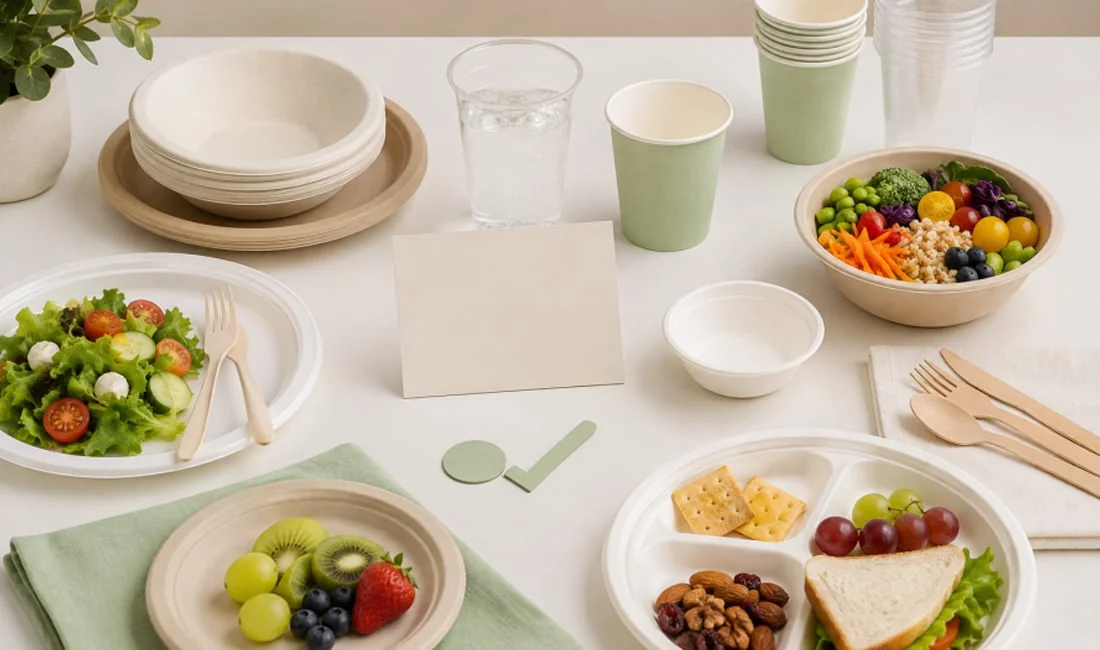
Disposable tableware can be safe for food service when it meets food-contact rules and is used as intended. However, no material is right for every meal or every temperature. A plate that works well for cold cake may not be suitable for hot, oily food. A cup made for cold drinks should not be filled with boiling liquid unless the product instructions allow it.
For buyers, the safest approach is to look beyond words such as “plastic,” “paper,” or “natural.” Material and food type matter. So do temperature, contact time, and product instructions.
This guide explains BPA, heat, food-grade claims, and PFAS. It also lists the documents a reliable disposable tableware supplier should provide in 2026.
Is Disposable Tableware Safe to Use in 2026?
Yes, compliant disposable tableware is generally safe when used as intended. That answer has an important limit. Disposable tableware is a large product group. Plates, bowls, cups, trays, and cutlery may use different materials. They may also be made for very different foods.
Food-contact safety is based on intended use. In the United States, the FDA reviews how a substance may move into food. It also studies the exposure that may result from the planned use. It does not treat every food-contact article as fit for every condition. The FDA uses separate food types and use conditions in its food-contact system.
Before ordering disposable party supplies, buyers should check five basic factors.
| Safety factor | What buyers should check |
|---|---|
| Food contact | Is the product intended for direct contact with food or drinks? |
| Temperature | Is it made for cold food, hot food, hot drinks, or microwave use? |
| Food type | Is it suitable for oily, acidic, watery, or alcoholic food and drinks? |
| Contact time | Will food be served at once or remain in the item for several hours? |
| Product condition | Is the item clean, undamaged, odor-free, and free from color transfer? |
When Disposable Tableware Is Generally Safe
Disposable tableware is generally safe when the finished product meets the rules of its target market. The user must also follow its stated limits. It should be stored in clean, dry packaging. It should only be used for the food types and heat levels listed by the maker or supplier.
For example, a cold-drink cup can be a safe choice for water, soda, or juice. That does not make it fit for hot coffee. In the same way, a plate may safely hold a warm meal. It may not be made for microwave heating.
When Disposable Tableware May Be Used Incorrectly
Problems often come from a mismatch between the product and the job. One example is pouring very hot liquid into a cold cup. Another is putting a decorated plastic plate in an oven. Keeping oily food on a paper plate beyond its stated time limit can also be a poor match.
Damage also matters. Cracked, warped, cloudy, peeling, or strongly scratched items should not be used. If a product develops an unusual smell, loses color, or becomes too soft to hold food safely, it should be replaced.
What Does Food-Grade Disposable Tableware Mean?
“Food-grade” is a common sales term. Buyers should not treat it as a full safety standard on its own. In purchasing, it should mean that the product is fit for food contact under stated conditions. It should also meet the rules in the market where it will be sold or used.
The stronger question is not only, “Is it food-grade?” It is, “Is this finished product suitable for this food, at this temperature, for this length of time?”
Food-Grade Does Not Mean Suitable for Every Use
A food-contact plate is not automatically oven-safe. A cup approved for cold drinks is not automatically safe for hot drinks. A bowl designed to serve hot soup is not automatically safe for reheating that soup in a microwave.
Terms should be read separately:
• Suitable for food contact means the product is intended to touch food under defined conditions.
• Suitable for hot food means it can serve food within the stated temperature and time limits.
• Microwave-safe means the manufacturer specifically allows microwave use under stated instructions.
• Freezer-safe means the product can handle the stated low-temperature use.
• Oven-safe is a separate claim and should never be assumed for ordinary disposable tableware.
Food Contact Compliance and Intended Conditions of Use
Food-contact review covers more than the main material. A finished item can also contain coatings, inks, colors, glues, or process aids. The status of each relevant part matters. Its possible movement into food during planned use also matters.
The FDA explains that a food-contact substance is reviewed for its planned use. This includes possible movement into food and the resulting exposure. Its reference tables also separate food types and use conditions. These range from high-heat sterilization to cold storage and room-temperature use. Buyers can review the FDA’s Food Types & Conditions of Use for Food Contact Substances for the formal U.S. system.
This is why one universal temperature limit cannot be assigned to all plastic, paper, or plant-fiber tableware. The exact product specification should control the decision.
Documents Buyers Can Request from a Disposable Tableware Supplier
A supplier should be able to connect safety information to the exact product, material, and market. Depending on the order and buyer requirements, useful documents may include:
• A food-contact compliance declaration
• A product or material specification
• A test report from a qualified laboratory
• Recommended temperature and contact-time limits
• Intended food types and use conditions
• Evidence supporting BPA-free, PFAS-related, or other substance claims
• Batch, model, or SKU details that link the documents to the goods
A general factory certificate does not prove that every item has the same food-contact performance. Buyers should check the product name, model, material, and test scope. Each detail should match the item being purchased.
Is BPA in Disposable Tableware a Safety Concern?
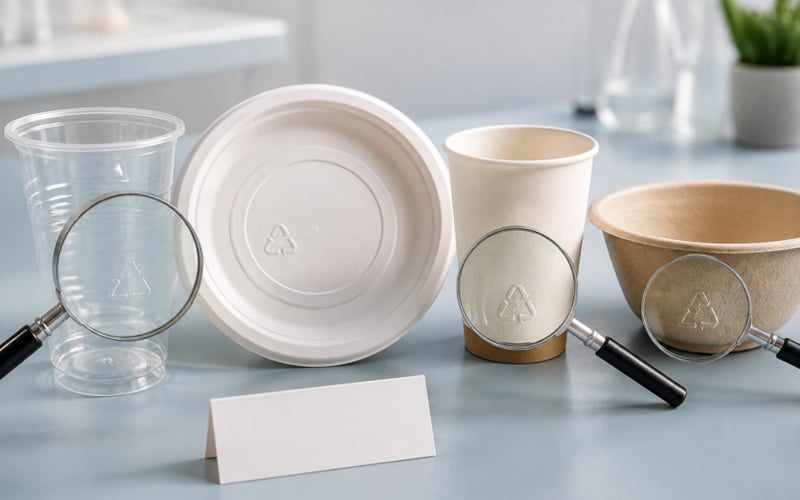
BPA is a specific chemical, not another name for plastic. It has been used in certain polycarbonate products and epoxy resins. It should not be assumed that every plastic plate, cup, or fork contains BPA.
What Is BPA and Where May It Be Used?
Bisphenol A, or BPA, is used to make some hard, clear polycarbonate plastics. It has also been used in epoxy resin coatings, including some coatings inside metal food and drink cans. The exact material and manufacturing formula determine whether BPA is relevant to a product.
For disposable tableware buyers, appearance is not enough. A clear plate cannot be identified as BPA-containing or BPA-free by sight. The buyer should use the supplier’s material details and supporting documents.
Does BPA-Free Mean Disposable Tableware Is Completely Safe?
No. BPA-free is a narrow claim. It addresses BPA, but it does not answer every safety question about the finished product.
A BPA-free plate may still have temperature limits. A BPA-free cup may still be intended only for cold drinks. The claim also does not confirm whether inks, coatings, or other components are suitable for direct food contact.
For this reason, “BPA-free” should be checked together with:
The base material
• Food-contact compliance
• Heat and microwave instructions
• Food type and contact time
• The rules of the destination market
“Chemical-free” should be avoided as a safety description. All materials are made of chemicals. Clear, specific claims are more useful and easier to verify.
Why BPA Rules Differ Between the United States and Europe
BPA requirements are not the same in every market. As of 2026, U.S. and EU buyers should not use one region’s rule as proof of compliance in the other.
The FDA’s current published view supports the safety of BPA for approved uses in food containers and packaging. This view is based on the information now available. It covers approved uses and current exposure levels. It does not mean that every possible use is safe. Details are on the FDA page about BPA use in food-contact applications.
The European Union has taken a stricter approach. In December 2024, the European Commission adopted a BPA ban for food-contact materials under Regulation (EU) 2024/3190. The measure has limited exemptions and changeover periods for some uses. EU buyers should review the exact scope and current dates. They should not rely only on a broad “BPA-free” label. The European Commission gives an overview of its BPA ban in food-contact materials.
How Heat Affects Disposable Tableware Safety
Heat can change the way a material performs. It can also affect how substances move from a food-contact material into food. The result depends on the exact material, temperature, time, food type, and product design.
This does not mean that all heated disposable tableware is unsafe. It means that hot use needs a product made and tested for that condition.
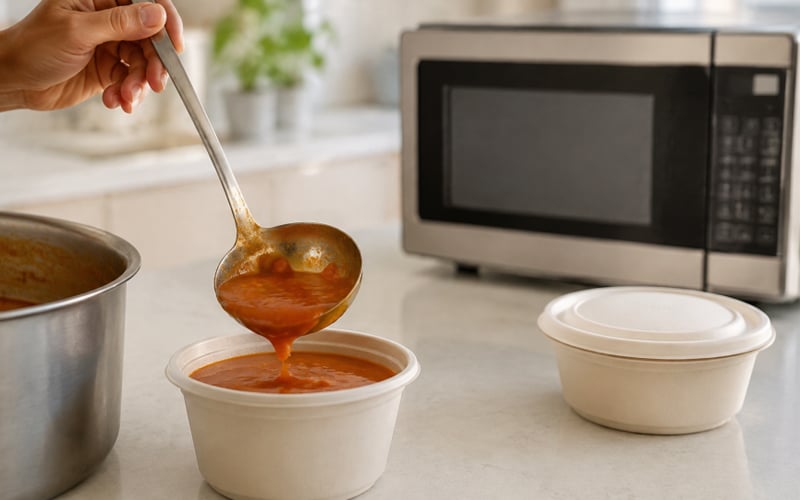
Serving Hot Food Is Not the Same as Microwave Heating
Serving and heating are different jobs. A plate may hold hot food for a short meal after cooking. Microwave use keeps heating the plate and food. It can also create uneven hot spots and a different heat pattern.
Therefore, “suitable for hot food” should not be read as “microwave-safe.” Microwave use should be allowed only when the product instructions clearly say so. The same rule applies to cups, bowls, lids, and cutlery.
Why Temperature, Time, and Food Type Matter
More heat and longer contact can raise the chance of movement or physical change. Food type can also affect the test conditions. Fatty, acidic, and watery foods may act in different ways. Alcoholic drinks can also need other use conditions.
The FDA recommends testing food-contact substances under the most severe temperature and time conditions expected for the proposed use. This supports a simple buyer rule: match the product to the real menu and service plan, not to a vague material category.
A short period of contact with warm bread is different from several hours of contact with hot, oily meat. A cold-water cup is different from a cup used for hot chocolate or an alcoholic cocktail.
Signs That Disposable Tableware Is Not Handling Heat Well
Users should stop using an item if it shows signs that the heat or food has exceeded its performance limits. Warning signs include:
• Softening or clear warping
• Cracks or leaks
• Separation of a coating or surface layer
• An unusual smell
• Color transfer to food, hands, or napkins
• A plate or bowl becoming too weak to carry food safely
These signs are not a home test for chemical safety. They are clear reasons to stop using a damaged or unsuitable item.
Can Disposable Tableware Go in the Microwave or Oven?
Only products that are clearly marked for microwave use should go into a microwave. Instructions may also limit heating time, power, food type, or lid position.
Ordinary disposable tableware should not go into an oven unless the maker clearly allows it. The same rule applies under a grill, over a flame, or on a hot plate. Metallic trims and decorative finishes need special care. A silver or gold look does not show what the trim is made from. Users should follow the label instead of guessing.
Disposable Tableware Safety by Material
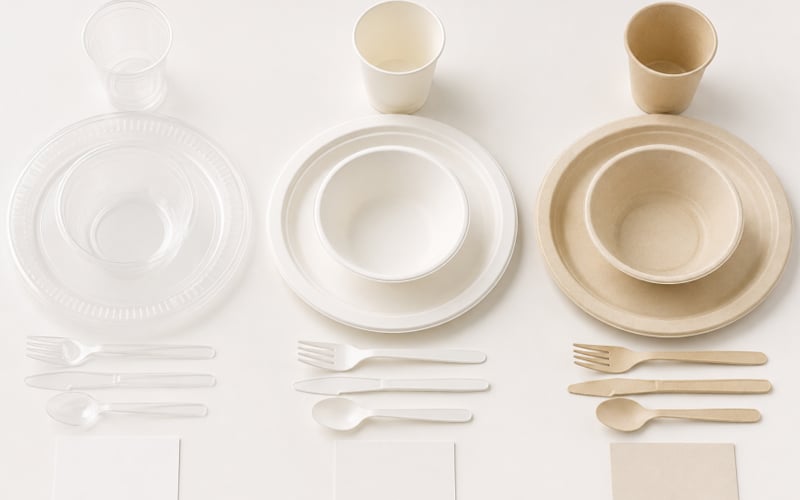
Material names help buyers narrow the options, but they do not replace finished-product information. Two products described as “plastic plates” or “paper bowls” may have different designs, additives, coatings, and use limits.
Disposable Plastic Tableware
Plastic disposable tableware can include several resin types, such as polypropylene or polystyrene, as well as other polymers. These materials do not have identical strength, clarity, heat response, or food-contact conditions.
Buyers should confirm the resin type when it matters to the application. They should also ask whether the finished article is intended for cold foods, warm foods, hot foods, or microwave use. Color, thickness, and clarity are not reliable ways to identify a resin or its safe-use limit.
For formal events and large guest lists, matching sets can make ordering easier. For example, a 600-piece silver disposable dinnerware set for 100 guests includes plates, cups, knives, forks, and spoons. Buyers should still check the product page and package before use. The planned food and heat level must fit the instructions.
Paper Disposable Tableware
Paper plates, bowls, and cups may include coatings, inks, adhesives, or grease-resistant structures. These parts can help control leaks and improve strength, but they are also part of the finished food-contact product.
“Made of paper” does not automatically mean that an item is suitable for very hot, oily, or wet food. A paper plate that works for cake may perform differently with soup or a heavy meal. Buyers should check leak resistance, grease resistance, heat instructions, and the intended contact time.
Bagasse and Plant-Fiber Disposable Tableware
Bagasse and other molded plant-fiber products can provide a firm shape for plates, bowls, trays, and divided meal plates. However, a natural raw material does not remove the need for finished-product testing.
Buyers should check the full product specification, including any added barrier, colorant, or processing aid. They should also keep food-safety and environmental claims separate. “Compostable” or “biodegradable” describes an end-of-life property under certain conditions; it does not prove food-contact compliance or suitability for every temperature.
For menus that need separate sections, compostable five-compartment plates can help keep foods apart. The item’s current instructions and documentation should be reviewed for the planned food, temperature, and disposal system.
PFAS and Other Disposable Party Supplies Safety Questions
BPA receives much of the attention, but it is not the only substance buyers ask about. PFAS, coatings, inks, and decorations may also be relevant, depending on the material and intended use.
What Buyers Should Know About PFAS in Paper Food Packaging
Some PFAS were used to block grease on paper and paperboard food packaging. In February 2024, the FDA said PFAS substances were no longer sold in the U.S. market for that use. In January 2025, it also found that 35 related food-contact notices were no longer in effect. The listed uses had been dropped.
This is an important U.S. market change, but its scope is limited. It covers PFAS substances used to block grease on paper and paperboard food packaging. It does not prove that every food-contact product in every market is free from every PFAS. Buyers can review the FDA’s page on the market phase-out of PFAS grease-proofing substances.
If a buyer requires a PFAS-free claim, the supplier should provide evidence for the exact finished item and the target market. A general statement about paper is not enough.
Do Colors, Coatings, and Decorations Affect Food Contact Safety?
They can. Decorative rims, printed patterns, coatings, and adhesives are parts of the finished product. Suppliers should identify which surfaces are intended to contact food and whether the decoration is included in the product’s compliance review.
Users should not assume that a metallic-looking rim contains metal or that it is suitable for heating. They should also avoid products with peeling decoration, visible wear, or color transfer. The label and supplier instructions should guide use.
How to Choose Safe Disposable Tableware and Disposable Party Supplies
Safe purchasing starts with a clear use case. A buyer who gives the supplier a full menu, service temperature, event length, and destination market is more likely to receive a suitable recommendation.
Check the Product’s Intended Use
The product description should state whether the item is intended for direct food contact and what it is designed to hold. Buyers should check each part of a set. Plates, cups, and cutlery in the same color collection may not share the same heat limits.
If the use is not stated, the buyer should ask before placing a large order. “Party plate” or “premium cup” describes style, not a technical condition of use.
Match Disposable Tableware to the Menu
The menu is one of the best purchasing tools. Buyers should separate their needs into clear groups:
• Cold and room-temperature foods
• Warm or hot foods
• Dry, wet, oily, or acidic dishes
• Cold drinks and hot drinks
• Low-alcohol and higher-alcohol drinks
• Food served at once and food held for a longer period
This list helps the supplier recommend the right plate, bowl, cup, or tray. It can also show when an event needs more than one material or product type.
Review Labels and Supplier Information
Buyers should compare the label, online product page, specification, and test documents. The information should agree. Product codes and material names should match, and the report should cover the intended market and use.
Safety statements should also be specific. “Microwave-safe for up to X minutes under stated conditions” is more useful than “high heat resistant.” “Tested for direct food contact” is more useful when the supplier can name the test basis and product model.
Avoid Products with Missing or Unclear Safety Details
Buyers should pause when a product has:
• No clear material information
• No statement that it is intended for food contact
• Vague temperature claims
• A report that cannot be linked to the product
• Only broad terms such as “eco-friendly,” “natural,” or “non-toxic”
• Different safety claims on the package and product page
Low price does not correct missing information. For bulk orders, buyers should resolve these questions before production or shipment.
Safe Use Tips for Disposable Tableware at Parties
Correct handling protects both guests and the appearance of the table. Event teams should make product instructions part of setup, service, and cleanup.
Before Serving Food
Packages should be stored in a clean, dry area away from chemicals and strong odors. Before service, staff should check for dust, damage, unusual smells, moisture, or broken packaging.
Items for cold drinks, hot drinks, cold food, and hot food should be separated when they have different limits. This reduces mistakes during a busy event.
During the Event
Food and drinks should stay within the product’s stated conditions. Disposable tableware should be kept away from open flames, heating elements, grills, and hot pans.
Hot drinks and soups also need stable handling. Cups and bowls should be placed on flat surfaces, filled to a safe level, and carried in a way that limits spills. A sleeve, saucer, tray, or double-cup method should be used only when the product supplier recommends it for that system.
After Use
Disposable tableware should not be assumed to be washable or reusable. Reuse is appropriate only if the manufacturer clearly permits it and provides cleaning and inspection instructions.
Any item that is cracked, warped, heavily scratched, cloudy, stained, or peeling should be discarded. Waste should then be sorted according to the product claim and the local collection system. A compostable label does not mean an item will break down in every home compost pile or landfill.
Disposable Tableware Safety Checklist for Buyers
Before approving a product or bulk order, buyers can use this short checklist:
• Is the product intended for direct food contact?
• What is the exact material of each food-contact part?
• Is it intended for cold food, hot food, cold drinks, or hot drinks?
• Is microwave use clearly allowed?
• Are maximum temperature and contact time stated when needed?
• Is it suitable for oily, acidic, or alcoholic foods and drinks in the menu?
• Do the declaration and test report match the exact product or SKU?
• Does the product meet the requirements of the destination market?
• Are BPA-free, PFAS-free, compostable, and other claims supported separately?
• Are storage, use, and disposal instructions available to event staff?
FAQs About Disposable Tableware Safety
Is All Disposable Plastic Tableware BPA-Free?
It should not be assumed. BPA is associated with certain materials and applications, not with all plastics. Buyers should check the material specification and the supplier’s evidence for the exact product.
Can Disposable Plates Hold Hot Food?
Some can, but the product must be designed for that use. Buyers should check the stated temperature, contact time, and food type. A plate that can serve warm food is not automatically microwave-safe.
Is Microwave-Safe Disposable Tableware Safe for an Oven?
No. Microwave-safe and oven-safe are different claims. Disposable tableware should not go into an oven unless the manufacturer clearly allows that exact use.
Is Paper Disposable Tableware Safer Than Plastic?
There is no universal answer. Safety depends on the finished product, including coatings, inks, adhesives, use conditions, and compliance. A well-specified product used correctly is a better choice than selecting by material name alone.
Are Bagasse Plates Automatically BPA-Free and PFAS-Free?
Buyers should not rely only on the plant-fiber name. Claims should be supported for the finished product, including any coating or additive. Food-contact safety, BPA status, PFAS status, and compostability are separate questions.
Can Disposable Tableware Be Washed and Used Again?
Not by default. Some sturdy products may include manufacturer-approved reuse instructions, while others are designed for one use. Buyers and users should follow the instructions for the exact item and stop reuse if it becomes cracked, warped, cloudy, scratched, or damaged.
How Can Buyers Verify That Disposable Party Supplies Are Food-Grade?
They can ask for a compliance declaration, product specification, relevant test report, intended-use limits, and proof that the documents match the exact item. They should also confirm that the information covers the market where the product will be sold or used.
Choose Disposable Tableware That Fits Its Intended Use
Disposable tableware safety is not decided by one label. It comes from a suitable material, compliant components, clear instructions, correct temperature, the right food type, and responsible use.
Wonderful Party provides coordinated disposable tableware and party supplies for weddings, birthdays, catering, and large gatherings. Buyers can visit the Wonderful Party website to compare suitable styles and pack sizes for their event.