

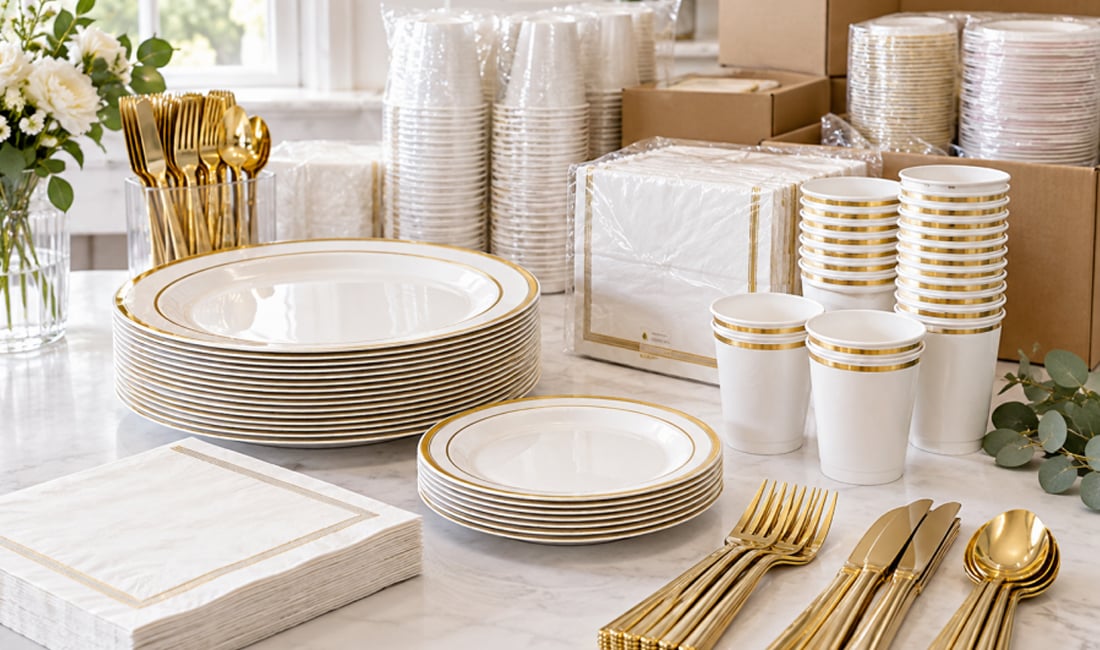
A large box of disposable tableware can look like a good deal until the contents are counted. There may be enough dinner plates for every guest, but too few cups for the drinks station. Another set may include dozens of spoons that the menu does not require.
The best bulk purchase is not always the largest pack or the one with the lowest price per piece. It is the combination that covers the planned service at a sensible total cost, without leaving behind supplies that have no clear use.
For buyers planning to buy party tableware in bulk, the process starts with three questions: how many pieces will the event use, which packs cover those needs, and whether a discount reduces the final bill. This guide explains how to answer each one, with quantity examples, pack calculations, and practical buying advice.
What Comes in Bulk Disposable Tableware Packs?
Bulk tableware can be purchased as coordinated dinnerware sets or as separate packs of individual items. The distinction matters because a package’s total piece count does not show how many complete meals it can support.
Disposable Dinnerware Sets for Complete Place Settings
A disposable dinnerware set brings several types of tableware into one package. Depending on the product, this may include dinner plates, smaller plates, cups, cutlery, and napkins.
For example, a listed 350-piece disposable dinnerware set includes 50 dinner plates, 50 dessert plates, 50 cups, and 50 pre-rolled napkins with cutlery. The package count covers the individual components, not 350 guests.
A set can provide a useful starting point when its contents match the menu. However, “service for 50” should not be treated as a complete supply plan for every 50-person event. A separate dessert course may need fresh forks. A longer drinks service may need more cups.
The useful number is the quantity of each item inside the box.
Single-Item Packs of Disposable Plates, Bowls, Cups, and Cutlery
Separate packs allow buyers to order different quantities for different parts of the meal. This approach suits an event that needs many cups, fewer knives, and no bowls.
The product category still needs a closer look. A plate-only pack may contain several sizes rather than one uniform stack. One 100-piece white-and-gold plate pack, for instance, contains 50 dinner plates measuring 10.25 inches and 50 dessert plates measuring 7.5 inches. It does not provide 100 dinner plates.
For a clear comparison, the shopping list should record the item type, size, quantity per pack, and intended use. “Two packs of plates” is less useful than “100 dinner plates and 100 dessert plates.”
How Much Disposable Tableware Is Needed per Guest?
A useful estimate begins with the menu and the way food will be served. The same guest count can produce very different orders for a seated dinner, a buffet, and a dessert reception.
The examples below are planning assumptions, not fixed industry requirements. They should be adjusted to suit the actual event. The guest count should also include any staff or vendors receiving meals from the same supplies.
Disposable Dinner Plates, Dessert Plates, and Bowls
For a seated meal with one main course, one dinner plate per guest provides the starting count. A separate cake or dessert service adds one smaller plate per person receiving dessert.
Additional food services need their own allowance. An appetizer station before dinner should not quietly borrow the dessert plates unless the order includes enough for both uses.
Bowls belong on the list only when the menu calls for them. A soup course, individual salad, or ice cream service may require a bowl, but those uses do not always need the same size. A small dessert bowl should not be counted as a full-meal bowl.
For example, if 30 of 50 guests are expected to take a bowl-served dessert, the starting requirement is 30 bowls, plus the chosen reserve. There is no need to automatically purchase one for every attendee.
Serving trays and shared bowls also need a separate count. They support the food display rather than individual place settings. For a buffet, allowing spare serving dishes can support replacing nearly empty dishes with freshly filled ones instead of topping them up, as the FDA advises.
Cold Cups, Hot Cups, and Specialty Disposable Drinkware
Cup quantities should follow the number of new cups expected to be issued, not simply the number of people attending.
For the worked example in this guide, the plan allows two cold-drink cups per guest. That is a starting assumption for this event, not a universal limit or a reliable estimate for every open-ended drinks service.
Coffee and tea require a separate count based on expected demand. The purchasing list should specify cups labeled by the supplier for the intended drink temperature. A cold-drink cup should not be assigned to hot coffee merely because its size is convenient.
Specialty drinkware can be counted in the same way. A single planned toast needs one suitable glass per participant, plus a reserve. Additional wine or cocktail service needs a separate estimate if new glasses will be issued.
This separation prevents a common planning gap: an order may contain plenty of drinkware overall while still being short of the particular cup needed at one station.
Disposable Cutlery and Napkins
Forks, knives, and spoons should be counted separately.
For the dinner-and-cake example below, the plan uses one fork for the main meal and a fresh fork for dessert. That creates a starting requirement of two forks per guest. It also allows one knife per guest for the main course.
Spoons are not included because this example has no spoon-served dish. A different dessert or a soup course would change that decision.
Napkins deserve their own line rather than being treated as part of a complete set. This example allows three per guest across the meal, dessert, and drinks service. A seated lunch and a sauce-heavy cookout may need different allowances, so previous event records are useful when available.
Extra Supplies for Buffets and Longer Events
A reserve should cover small uncertainties, such as dropped items or unexpected replacements. It should not be expected to cover a known second meal or an entire extra service.
For the table below, the reserve is 10% of the calculated starting quantity, rounded up to the next whole piece. This is an illustrative allowance, not a guarantee against shortages.
The event assumptions are one seated main meal, a separate cake service, two cold-drink cups per guest, and no bowls, hot cups, or spoons.
|
Item |
Starting quantity per guest |
25 guests |
50 guests |
100 guests |
|---|---|---|---|---|
|
Dinner plates |
1 |
28 |
55 |
110 |
|
Dessert plates |
1 |
28 |
55 |
110 |
|
Cold-drink cups |
2 |
55 |
110 |
220 |
|
Forks |
2 |
55 |
110 |
220 |
|
Knives |
1 |
28 |
55 |
110 |
|
Napkins |
3 |
83 |
165 |
330 |
These totals already include the 10% reserve. They are target quantities before subtracting existing stock or rounding up to available pack sizes.
A buffet with planned second helpings needs a different plate calculation. If 50 guests receive an initial plate and 20 are expected to return for another, the starting requirement is 70 dinner plates. With the same illustrative 10% reserve, the target becomes 77.
The calculation is:
Target quantity = planned use + reserve
Known demand comes first. The reserve is added afterward, once.
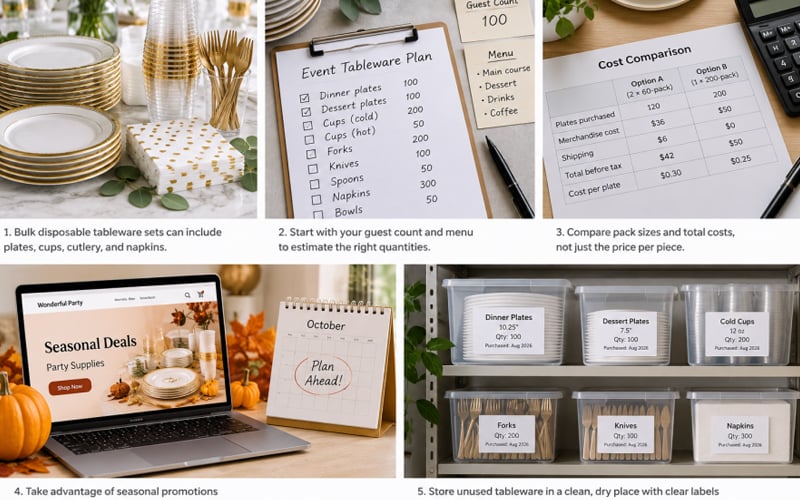
How to Choose Bulk Disposable Tableware Without Overbuying
Once the target quantities are clear, the next step is turning them into a practical order. This is where pack contents matter more than a large number on the product title.
Match Pack Contents to the Menu
Each item on the order should have a job.
Dinner plates should suit the planned portions. Bowls should match the dish and serving size. Cups should suit the drink, while cutlery should be appropriate for the foods being served.
The product description should also be checked for any use limits before a large order is placed. A low price does not solve a mismatch between the product and the meal.
A simple written menu helps keep the order focused. Instead of adding bowls “just in case,” the buyer can connect them to soup, salad, or dessert. If no dish needs them, they can remain off the list.
Compare Dinnerware Sets with Separate Packs
A dinnerware set is worth considering when most of its contents have a clear use. Separate packs deserve closer attention when the required quantities are uneven.
For example, a dinner with cake may need twice as many forks as knives. A drinks-heavy reception may need several cup packs but few dinner plates. Buying another complete set to solve one shortage adds every other component again.
The fair comparison is between two complete shopping baskets: the chosen sets plus their necessary additions, and a separate-pack order that covers the same list.
Neither method is automatically cheaper. A discounted set may still be the better purchase even if some pieces remain unused. The decision should come from the total bill and realistic future use, not a rule that sets are always better or always wasteful.
Count Existing Stock Before Rounding Up
Usable stock should be deducted before the number of packs is calculated.
Suppose the target is 55 dinner plates and 12 suitable, protected plates are already available. The remaining need is 43. If the selected plates come in packs of 25, two packs supply 50 more, bringing the total stock to 62.
Rounding the full target to three packs first would lead to an unnecessary extra pack.
For a single-item pack, the calculation is:
Packs to buy = remaining quantity needed ÷ pieces per pack, rounded up
Existing stock should only count if it suits the event. A stack of small dessert plates cannot fill a shortage of dinner plates. Supplies already reserved for another booking are not available stock either.
Add Extra Pieces Only Where Needed
The 50-guest example shows how a set and selected additions can work together.
For illustration, assume the chosen dinnerware set contains 50 of each item listed below. The organizer also has a small amount of suitable stock. The target quantities come from the earlier table and already include the reserve.
|
Item |
Target quantity |
Existing stock |
Supplied by set |
Still needed |
|---|---|---|---|---|
|
Dinner plates |
55 |
5 |
50 |
0 |
|
Dessert plates |
55 |
5 |
50 |
0 |
|
Cold-drink cups |
110 |
10 |
50 |
50 |
|
Forks |
110 |
10 |
50 |
50 |
|
Knives |
55 |
5 |
50 |
0 |
|
Napkins |
165 |
15 |
50 |
100 |
The remaining list is now specific: 50 cups, 50 forks, and 100 napkins. If matching packs are available in those quantities, three additions complete the order without buying another full dinnerware set.
Actual pack sizes may differ, so the final basket still needs checking. Any extra spoons supplied by the set should also be recorded, even though this menu does not require them.
When plates alone need restocking, a dinner and dessert plate combination can be useful if both sizes are needed. If only one size is short, a single-size pack may be a closer fit.
The aim is not to eliminate every spare piece. It is to avoid buying an entire second collection to solve one small gap.
How to Compare Bulk Disposable Tableware Prices
Price per piece is useful only when the pieces are comparable.
A dinner plate should be compared with a similar dinner plate, not a smaller dessert plate. For mixed sets, dividing the price by every item can hide the fact that some contents are not needed.
A more useful starting point is:
Total purchase cost = discounted merchandise cost + shipping + applicable tax + necessary add-on costs
Online price comparisons should account for delivery and other charges, rather than relying on the first displayed price. Product details and the terms of the offer also need to match the buyer’s needs.
Consider this hypothetical comparison for a target of 110 dinner plates:
|
Cost or quantity |
Option A: Two 60-plate packs |
Option B: One 200-plate pack |
|---|---|---|
|
Plates purchased |
120 |
200 |
|
Merchandise cost |
$36 |
$50 |
|
Merchandise cost per plate |
$0.30 |
$0.25 |
|
Shipping |
$6 |
$0 |
|
Total before tax |
$42 |
$50 |
|
Plates beyond the target |
10 |
90 |
These are illustrative figures, not current product prices or offers. Applicable tax must be added when comparing actual orders.
Option B has the lower merchandise price per plate. However, it costs $8 more before tax and leaves 80 more surplus plates than Option A.
That may be worthwhile for a buyer with another confirmed event. It is less persuasive when those plates have no planned use.
Shipping thresholds need the same check. Spending another $16 on unwanted supplies to avoid an $8 delivery fee increases the bill by $8. Adding an item already required for the event is a different decision.
The best measure of value is the cost of meeting the planned need, not the discount percentage alone.
When Is the Best Time to Buy Disposable Tableware in Bulk?
The best buying window depends on how settled the requirements are, how flexible the design can be, and how much time remains before the event.
A promotion is useful when it supports a clear order. It is less useful when it encourages an order before the menu or guest count has been worked out.
Seasonal Promotions for Planned Events
Available October promotions, Black Friday offers, and other seasonal sales can be treated as opportunities to compare prices. They should not be treated as proof that every included product is at its lowest possible price.
A prepared shopping list makes those comparisons easier. The buyer can check the same sizes, pack quantities, and required additions rather than switching to a much larger set because its discount looks stronger.
Coupon codes and shipping offers are worth checking alongside the listed price. The FTC’s holiday shopping guidance likewise recommends comparing products and looking for relevant discounts or delivery offers.
For tableware, the useful question is simple: does the promotion reduce the cost of the supplies already needed?
Post-Holiday Clearance for Flexible Designs
A clearance purchase makes sense when the remaining design suits a future event.
Plain white plates, clear cups, or simple metallic accents could fit several planned themes. A product printed with a specific year or holiday message has a narrower use. Buyers can judge that difference before assigning value to the leftover stock.
The future event should be reasonably clear. A discounted case for a confirmed annual gathering is easier to justify than one bought for an occasion that may never happen.
Return restrictions also deserve attention before a clearance order is placed. Store policies and deadlines vary, so a buyer should not assume that an unopened pack can be returned months later.
Early Ordering When Matching Stock Matters
When the event requires a large quantity of one exact design, waiting for another discount creates a tradeoff. A later order may be cheaper, but the buyer also needs enough time to receive, inspect, and correct it.
The order date should be worked backward from the event. It should allow for the stated processing and delivery time, a check of the contents, and a practical chance to resolve shortages or damage.
For a large or made-to-order purchase, the supplier should confirm the schedule for that specific order. A delivery estimate shown for a small retail pack should not be used as a promise for every order size.
Shipping information, tracking options, and return terms should be reviewed before checkout. Those details form part of the buying decision, not an afterthought once the supplies arrive.
How to Store Bulk Disposable Tableware Between Events
• Check storage space before ordering. The full order should fit in a clean, dry area without crowding or damaging the packaging. A larger pack is only practical when there is room to store it properly.
• Keep unused tableware covered. Plates, cups, and cutlery should remain in their original protective packaging or a suitable covered container, away from dust, splashes, and moisture.
• Label boxes and update quantities. Each box should show the item type, size, color, purchase date, and remaining count. After each event, the recorded quantity should reflect what is actually left—not the original pack total.
• Open packs as needed during the event. Supplies can be brought out in smaller batches rather than unpacked all at once. This keeps more of the unused stock protected for future occasions.
• Check leftovers before returning them to storage. Only clean, unused, properly protected items should count toward the next event. Used items or supplies with uncertain cleanliness should not be mixed back into stored stock.
• Record actual use for future orders. A brief log of guest numbers, service style, quantities used, and usable leftovers gives repeat buyers a clearer basis for the next purchase.
FAQs About Buying Disposable Tableware in Bulk
Is a Business Account Required to Buy Disposable Tableware in Bulk?
Not necessarily. A large pack offered through ordinary retail checkout is different from a separate wholesale purchasing program. The number of pieces in a box does not, by itself, determine the account requirements.
Buyers seeking trade pricing should check the supplier’s terms for that arrangement. Those terms may need to be confirmed separately from the retail product listing.
Should a Small Pack Be Tested Before Placing a Large Order?
A small trial purchase can be useful when the product is unfamiliar or the event has strict requirements.
The check should focus on the actual use: whether the plate fits the planned portion, whether the cutlery suits the food, and whether the color works with the table setting. Products should only be tested within their stated use limits.
A trial pack is not a substitute for checking the full order on arrival, and it does not guarantee that a supplier offers free samples.
Can Unopened Packs from a Bulk Order Be Returned?
That depends on the seller’s policy and the terms of the purchase. An unopened package may still be outside the return period or subject to other conditions.
Before ordering surplus stock, buyers should confirm the deadline, packaging requirements, return shipping responsibility, and any applicable fees. The FTC recommends checking these terms before an online purchase.
For buyers ordering well ahead of an event, the key question is whether any return option would still be available after the event. It should not be assumed.
Build a Bulk Tableware Order That Fits
A well-planned bulk order starts with the meal, not the biggest box. Guest numbers define the starting demand. Separate counts for plates, cups, cutlery, and napkins reveal the real requirements. Existing stock and pack sizes then turn those requirements into an order.
Before checkout, three details should be clear: each item has a purpose, each quantity covers the planned service, and the final cost has been checked. With that list in hand, buyers can explore Wonderful Party for a suitable dinnerware set and the extra pieces needed to complete it. The goal is enough tableware for the event, with any remaining stock tied to a realistic next use.