

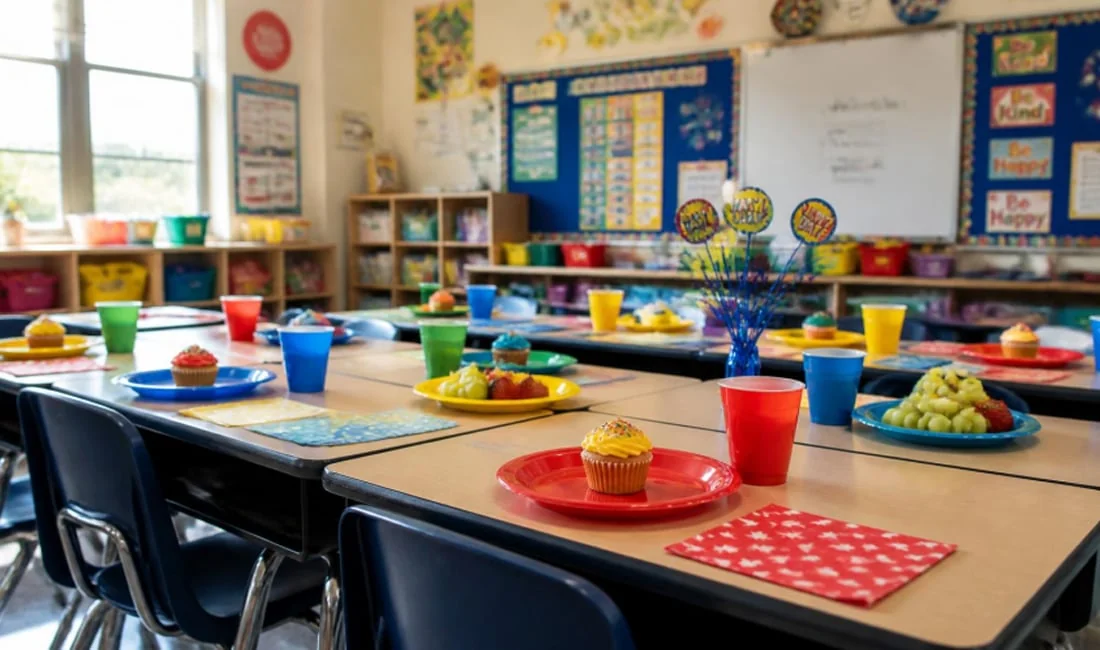
A classroom party runs on a short clock. Most last 30 to 60 minutes. The room holds 20 to 30 students, one small trash can, and no kitchen sink. Every plate, cup, and napkin has to work inside those limits.
This guide looks at back-to-school classroom party supplies from a supplier’s side of the table. It covers what to buy, how much to order, and how to match plate size, cup size, and napkin count to a real classroom. Teachers and room parents can use the charts to place one order and skip the guesswork.
Why Disposable Tableware Is the Right Call for a Classroom Party
Disposable tableware fits a classroom party because the room was never built to serve food. Five limits shape every choice a teacher makes.
No sink. Most classrooms have a small hand-wash basin or none at all. Washing 25 plates during a 45-minute party is not possible.
A short window. A party that starts at 1:45 and ends at 2:30 leaves about five minutes for cleanup. Disposable plates, cups, and cutlery go straight into a bag.
Small desks. Each student gets a desk, not a dining table. The surface has to hold a plate, a cup, and a napkin at the same time.
One trash can. A single classroom bin fills up fast. Lightweight, stackable items take up far less space than food containers.
A tight budget. Many teachers pay for classroom party supplies out of pocket. Bulk sets lower the cost per student.
Disposable does not have to mean throwaway. Wonderful Party’s rigid plastic plates, cups, and cutlery are built for repeated use, so a teacher can rinse a set, store it, and bring it back for the next party. The supplier’s guidance is roughly 20 gentle hand-washes, or about five dishwasher cycles, and any piece that turns cracked, cloudy, or warped should be thrown out. That turns one order into three or four celebrations.
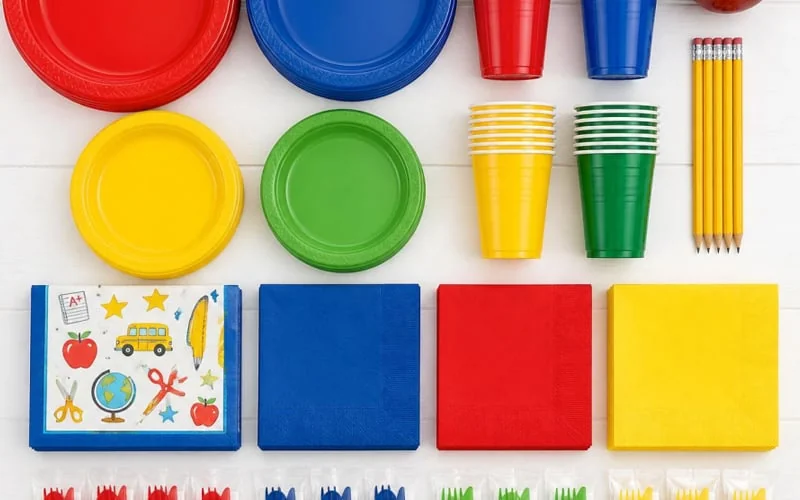
The Back-to-School Classroom Party Disposable Tableware Checklist
A complete classroom party setup needs three groups of items: core tableware, serving pieces, and a cleanup kit. The table below shows a full list for a class of 25.
| Item | Why It Matters in a Classroom | Qty for 25 Students |
|---|---|---|
| Dessert or snack plates (7 in.) | Fits a student desk, holds cupcakes and fruit | 50 |
| Cups (9 oz) | Small pour, low spill risk | 38 |
| Napkins | Doubles as a placemat and a wipe | 75 |
| Forks or spoons | One utensil per student, matched to the menu | 30 |
| Serving trays | Moves food from the counter to the desks | 2–3 |
| Serving bowls | Holds chips, popcorn, and fruit for self-serve | 2–4 |
| Serving utensils | Keeps hands out of shared food | 1 per dish |
| Food labels | Names each dish and flags allergens | 1 per dish |
| Trash bags | Two bags beat one overflowing bin | 3 |
| Wet wipes | Cleans desks after frosting and juice | 1 pack |
| Leftover bags or lids | Sends extra food home instead of into the bin | 5–10 |
Core Disposable Tableware: Plates, Cups, Napkins & Cutlery
Core tableware covers the four items every student touches: a plate, a cup, a napkin, and one utensil. Suppliers sell these four as a matched kit, sized by guest count.
A 50-guest kit is a useful reference point. It holds 100 plates, 50 cups, 50 napkins, and 50 cutlery sets. That works out to two plates, one cup, one napkin, and one utensil per guest. The plate count is right for a classroom. The napkin count is not, and the next section explains why.
Cutlery choice depends on the menu, not on habit. Forks handle cake, pasta salad, and fruit. Spoons handle ice cream, yogurt, and pudding. Knives rarely earn their place at a classroom party, since almost nothing needs cutting.
Serving & Setup Extras: Trays, Serving Bowls & Food Labels
Serving pieces control how fast the food moves. Two or three trays let volunteers carry plated snacks to desks instead of forming one long line at the front of the room.
Serving bowls hold the items students take themselves, such as pretzels, popcorn, and grapes. A separate serving utensil for each bowl keeps hands out of shared food. This is basic food safety, and most schools ask for it.
Food labels cost nothing and solve two problems. They name each dish, and they flag allergens for volunteers who arrive late. A label should carry the real food name, not only a themed nickname. “Apple slices” tells a parent more than “Teacher’s Favorite.”
The Cleanup Kit Teachers Always Forget
The cleanup kit is the part of the order that goes missing most often. Room parents sign up for cupcakes, juice, and decorations. Nobody signs up for trash bags.
Three items belong in every classroom party box. Trash bags come first, and two bags work better than one, since one can hold recyclables. Wet wipes come second, because frosting and juice land on desks, not on plates. Leftover bags come third, so extra food leaves the room instead of filling the bin.
A teacher who packs these three items can clear a room in under ten minutes. A teacher who forgets them spends the next class period cleaning.
How Many Disposable Plates, Cups & Napkins Per Student?
A class of 25 students needs about 50 plates, 38 cups, 75 napkins, and 30 cutlery sets. That covers one snack round, one dessert round, two drink pours, and a normal number of drops.
Most party kits under-supply napkins for school use. A kit built for adults gives one napkin per guest. A room of eight-year-olds eating frosted cupcakes needs three.
The Per-Student Formula for Snacks, Cake & Drinks
Wonderful Party’s own ordering guidance is to prepare basic tableware at 1.2 to 1.5 times the headcount, which leaves a spare margin for accidents. A classroom party applies that rule per course rather than per party, because most class parties serve a snack and a dessert. The formula below does that, using one multiplier per item.
• Plates: 2 per student. One plate carries the snack, and a second carries the cake or dessert. Two courses at roughly 1.2 to 1.5 times the headcount lands at two plates per student once spares are counted.
• Cups: 1.5 per student. Most students drink twice. Half of them set the first cup down and lose track of it.
• Napkins: 3 per student. One napkin works as a placemat on the desk. One handles the meal. One handles the mess afterward.
• Cutlery: 1 per student, plus 20%. Students drop forks. The extra 20% covers drops, volunteers, and late arrivals.
Add a buffer of four to six full sets on top of the total. That buffer absorbs three common surprises: a sibling who joins, a volunteer who stays for cake, and a stack of plates that gets knocked to the floor.
Quantity Chart by Class Size (20, 25, 30 & Whole-Grade Events)
The chart applies the formula to four common group sizes. Every figure already includes the buffer.
| Class Size | Plates | Cups | Napkins | Cutlery Sets |
|---|---|---|---|---|
| 20 students | 40 | 30 | 60 | 24 |
| 25 students | 50 | 38 | 75 | 30 |
| 30 students | 60 | 45 | 90 | 36 |
| Whole grade (100) | 200 | 150 | 300 | 120 |
Whole-grade events change the math in one way. Guest flow matters more than guest count. A grade-level assembly needs a second serving station, a second set of trays, and one adult per serving line.
How to Choose the Right Disposable Tableware for a Classroom Party
The right tableware for a classroom is strong enough to carry food across a room and small enough to sit on a desk. Six checks, taken in order, narrow the choice quickly.
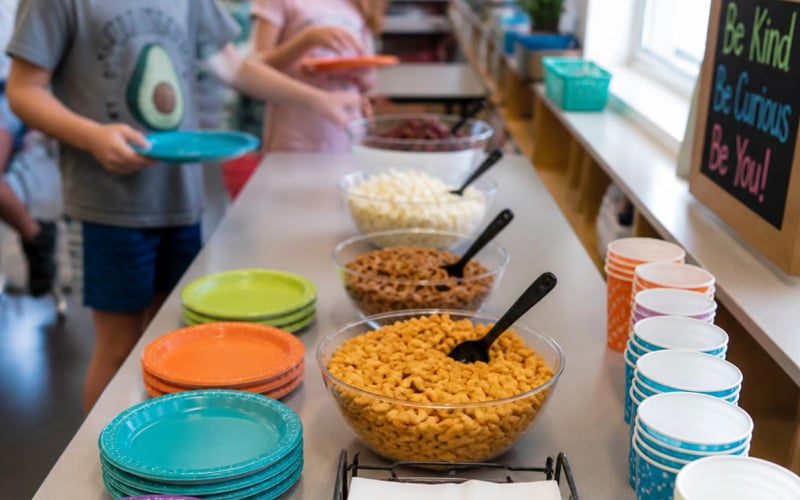
Start With the Material: Hard Plastic or Paper
Material sets the ceiling on strength, so it comes first. Classroom parties use two options: hard plastic and coated paper.
Hard plastic plates hold their shape under weight. A plastic plate carries a slice of pizza across a room without folding. It also survives a rinse, which means a teacher can wash it and reuse it at the next party. Wonderful Party’s plastic range is made from food-grade, BPA-free resin built for that kind of repeat use, and the brand also carries a plant fiber line in materials such as sugarcane pulp, bamboo pulp, and paper pulp.
Coated paper and plant fiber plates weigh less in a bag and compost after use. They also soak through faster under grease and sauce. For a snack party with dry food, paper works. For pizza, tacos, or anything warm, plastic holds up better. The full comparison of strength, cost, and cleanup sits in the paper vs plastic plates guide.
Match Plate Size to the Menu — and to the Desk
Plate size follows two limits: the food on it and the desk under it. A 7-inch plate satisfies both for most classroom parties.
• 6-inch plates suit small treats, such as cookies, brownies, and candy.
• 7-inch plates suit standard party food, such as cupcakes, fruit, and sandwich halves. This is the classroom default.
• 9-inch plates suit full portions, such as pizza slices, pasta, and taco plates.
The student desk is small. A 9-inch plate takes up most of the surface and leaves no room for a cup. That is how spills start. A 7-inch party plate in a bright color leaves desk space free and still reads as festive.
Two plate sizes cover a party with both a snack and a dessert. Many kits ship a dinner size and a dessert size in the same box for that reason. More detail on sizes and formats sits in the disposable plates buying guide.
Check Grease Resistance, Heat Tolerance & Sturdiness
Three physical properties decide whether a plate survives the walk from the serving table to a desk. Each one maps to a food a classroom actually serves.
Grease resistance matters for pizza, chips, and buttered popcorn. A plate that absorbs oil goes soft at the center and bends.
Heat tolerance matters for warm food, such as pizza, quesadillas, and baked pasta. Rigid party plates handle warm food well. They are not built for food straight from an oven, and most are not made for microwave use. The heat-resistant plates guide breaks down which materials handle which temperatures.
Sturdiness shows up at the rim. A stiff rim lets a student carry a plate with one hand. A thin rim folds, and the food slides off. Rim strength is the single best predictor of whether a plate works for children.
Separate Allergy-Safe Food on Dedicated Plates and Trays
Allergy safety at a classroom party depends on separation, not on the plate itself. Tableware carries no allergens. Cross-contact does.
Three habits handle it. Allergy-safe food gets its own plates, kept in a separate stack. It gets its own serving utensils, which never move to another dish. It gets its own tray, set apart from the main food line.
A compartment plate adds a fourth layer of protection by building the gap into the plate. A compostable five-compartment plate measures 10.25 by 8.25 inches, and its wells run from 2.28 to 4.92 inches across. One small well holds a nut-free treat while the larger wells hold shared food. The format was designed for children’s meals and school cafeteria service. One note on fit: at 10.25 inches it belongs on a serving table or a pair of joined desks, not on a single desk.
A second color helps volunteers keep track. When the nut-free tray uses blue plates and everything else uses white, a volunteer sees the difference from across the room. Full material and food-contact details sit in the disposable tableware safety guide.
Size Cups by Grade Level to Cut Spills
Cup size should match hand size, not thirst. A smaller cup spills less and refills fast.
• Pre-K and kindergarten: 5 to 7 oz. Small hands grip a narrow cup better.
• Elementary grades: 9 oz. This is the classroom standard and the most common kit size.
• Middle school: 9 to 12 oz. Older students hold a larger cup and drink more.
A half-full cup is the real spill control. Volunteers should pour to the halfway mark and offer refills. A 9 oz cup filled to 5 oz travels across a room; the same cup filled to 9 oz does not.
Cold drinks suit plastic party cups best, such as water, juice, and lemonade. Hot drinks belong in cups rated for heat, so cocoa and cider are better left to a different format.
Pick Napkins and Cutlery That Shorten Cleanup
Napkins and cutlery are the cheapest items in the order and the two that decide cleanup time. Both should be chosen for volume, not looks.
Napkins do three jobs at a classroom party: they line the desk, they wipe hands, and they wrap the trash at the end. Three per student is the working number.
Cutlery works best pre-sorted. Volunteers who bundle one fork inside one napkin before the party hand out a complete set in one motion. Loose cutlery in a cup slows the line and ends up on the floor. One utensil per student is enough when the menu needs only one.
Tips for Running a Clean, Safe Classroom Party
A clean classroom party comes down to four steps: clear the rules, separate the food, control the flow, and hand the work to the students. Each step removes a common failure point.
Check School Food and Supply Rules Before Ordering
School rules should be confirmed before any order goes in, because they change what a teacher can buy. A five-minute conversation prevents a returned box.
Four rules come up most often. Many schools accept only store-bought food with a printed ingredient label. Many run a nut-free classroom. Some restrict decorations, such as balloons, glitter, and anything hung from the ceiling. A few ask for advance approval for outside food.
Sealed, single-serve portions solve two of these at once. A pre-portioned snack keeps an ingredient label attached and keeps one student’s food away from another’s.
Keep Allergy-Safe Food Separated and Clearly Labeled
Every dish needs a label, and allergy-safe dishes need a physical gap. Labels alone do not stop cross-contact.
The allergy list comes from the teacher, not from a parent group chat. Teachers hold the accurate list, including non-food triggers, such as latex balloons, scented markers, and certain craft glues.
Each label should carry the dish name and its main allergens. A safe layout places allergy-friendly dishes at the front of the line, before shared bowls, so serving utensils never travel backward down the table.
Set Up an Assembly Line That Serves 25 Students in Five Minutes
An assembly line serves a full class in about five minutes. A single table with everyone crowded around it takes fifteen.
The order of stations matters. Plates come first, then food, then napkin and cutlery, then drinks last. Drinks go at the end because a student needs a free hand to carry a full cup.
Two rules keep the line moving. Volunteers pour drinks at a separate table, away from the food. And plates get pre-stacked in groups of five, so nobody digs through a shrink-wrapped pack while 25 students wait.
Give Students Jobs: Server, Napkin Runner & Cleanup Crew
Students should run part of the party, because the work gets done faster and behavior improves. Assigned jobs also cut the number of adult volunteers a teacher needs.
Four roles work well in a classroom:
• Servers hand out plates at the front of the line.
• Napkin runners deliver a napkin and a fork to each desk before the food arrives.
• Drink monitors carry cups to desks, two at a time.
• The cleanup crew walks the room with an open trash bag at the end.
Rotating the roles gives every student a turn across the school year. The roles also help a teacher hit a practical target. One adult for every six to eight students is the common guideline for classroom parties. Student helpers make that ratio easier to reach.
Timeline and Bulk Buying for Classroom Party Disposable Tableware
Classroom party tableware should be ordered two to four weeks ahead. Bulk sets cost less per student, and a firm guest count is what makes bulk buying safe.
Cost Per Student: What to Budget for a Class of 25
Cost per student is the only figure worth comparing, and it comes from one division. Kit price divided by guest count gives the per-student cost.
Suppliers size party kits by guest count, such as 25, 50, 75, and 100 guests. The per-student cost falls as the kit grows, because packaging and shipping spread across more servings. A 150-piece set for 25 guests works out near $1.16 per student. The same range at 300 pieces for 50 guests drops to about $0.78, and at 600 pieces for 100 guests to about $0.68. A single grade-level order therefore costs roughly 40 percent less per student than four separate classroom orders.
Two factors lower the figure further. Free shipping thresholds reward a single consolidated order over three small ones, and Wonderful Party ships free on orders over $59. Washable plastic sets spread the same cost across several parties, since a rinsed and stored set serves the fall party, the winter party, and the spring party. More ways to trim the total sit in the guide to saving on party supplies.
Four Weeks Out: Confirm the Date, Menu & Allergy List
Four weeks out is for information, not for shopping. Three facts have to be locked down before an order makes sense.
The date and time window come first, since a 30-minute party needs a simpler menu than a 60-minute one. The menu comes second, because pizza and ice cream call for different plates and utensils. The allergy list comes third, and it sets how many separate serving pieces the party needs.
A confirmed student count belongs in this step too. Guest count drives every quantity in the charts above.
Two Weeks Out: Order in Bulk and Split the Cost
Two weeks out is the ordering window. It leaves room for shipping and for a replacement if a box arrives short.
One matched kit beats separate packs of plates, cups, and cutlery. A kit arrives coordinated, and it removes the risk of ordering 50 plates and forgetting cups. A 150-piece set built for 25 guests covers a standard class in one box, and it typically holds plates, cups, knives, forks, and spoons. Napkins are usually not part of that count, so they need their own line on the order. A classroom needs three per student, which is the item most often missed.
Cost sharing keeps the party off a teacher’s own card. Three sources usually cover it: a parent sign-up sheet with the tableware listed as its own slot, the grade-level or PTA budget, and a small per-family contribution. Tableware goes unclaimed more than any other item on a sign-up sheet, so it should be listed by name and quantity.
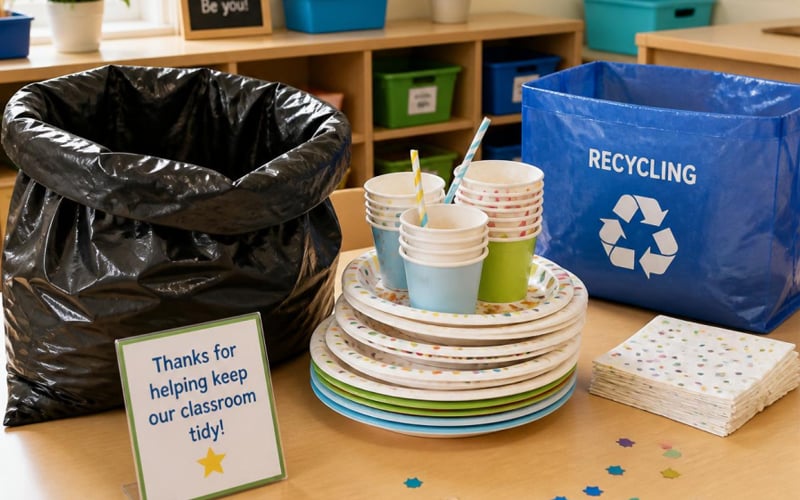
Party Week: Pack, Set Up & Prep the Cleanup Kit
Party week is for packing and staging, so party day holds no surprises. Three tasks fill it.
Two days out, plates get unwrapped and pre-stacked in groups of five, and forks get rolled into napkins. One day out, everything goes into a wagon or a rolling cart, since a teacher should not carry four boxes across a parking lot. Party morning, the serving tables get set in station order, and the trash bags come out before the food does.
A visible trash bag from the first minute changes student behavior. When the bin is easy to find, plates go into it without a reminder.
FAQs
How many plates do I need for a class of 25?
A class of 25 needs about 50 plates. The rule is two plates per student, one for the snack and one for dessert. Adding four to six spare plates covers drops and extra guests. Classes of 20 need 40 plates, and classes of 30 need 60.
Are paper or plastic plates better for school parties?
Plastic plates work better for most school parties. They hold their shape under greasy or warm food, such as pizza, tacos, and buttered popcorn, and a stiff rim lets a student carry a plate with one hand. Plastic sets also rinse clean and store for the next party. Paper plates cost less per piece and suit dry snacks, such as cookies, pretzels, and crackers.
Can disposable plates go in a classroom microwave?
Most rigid plastic party plates are not made for microwave use, so the label should always be checked first. Party plates are designed to hold warm food, not to heat it. A safer method is to warm food in the school kitchen or a shared microwave on a microwave-safe dish, then transfer it to party plates for serving.
What tableware works for a nut-free classroom party?
Any food-grade tableware works, because plates and cups carry no allergens. The risk is cross-contact, so the answer is separation. Nut-free food should get its own plates, its own serving utensils, and its own tray, placed at the front of the serving line. Using a second plate color for the nut-free station makes the difference visible to every volunteer.
How do I get classroom party cleanup done in under 10 minutes?
Three habits make a ten-minute cleanup realistic. Two trash bags should be open and visible from the start of the party, one for waste and one for recyclables. A student cleanup crew should walk the room with a bag while an adult wipes desks. And leftover food should go into take-home bags rather than the classroom bin, which fills up fastest.
Shop Back-to-School Classroom Party Tableware
A classroom party works best when the tableware matches the room. Small plates fit small desks. Heavy-duty plastic survives a walk across a classroom. A single matched kit removes the risk of missing cups on party day.
Wonderful Party supplies plates, cups, cutlery, bowls, napkins, and serving trays in sets sized by guest count, so one order covers a class of 25 or a full grade level. The rigid plastic sets rinse clean and store for the next celebration, which spreads one purchase across the whole school year. A compostable plant fiber range covers schools that run a composting policy, and bulk quotes are available for grade-level and school-wide orders.